The crying emoji 😭 is one of the most expressive emojis used in online conversations. Although it officially represents a face crying loudly with tears, people use it for many different emotions, including sadness, frustration, laughter, embarrassment, excitement, and emotional overwhelm.
Its meaning often depends on the conversation, the person using it, and the words around it. For example, someone might send 😭 after hearing sad news, while another person may use the same emoji after seeing something extremely funny.
Understanding the crying emoji can help you communicate more naturally through text messages, social media posts, comments, and online chats. This guide explains what 😭 means, when to use it, how it differs from other crying emojis, and how people commonly interpret it.
Quick Answer: What Does the Crying Emoji 😭 Mean?
The crying emoji 😭 usually expresses intense sadness, emotional pain, frustration, or being overwhelmed. However, online users also frequently use it to show extreme laughter, embarrassment, excitement, or emotional reactions.
The exact meaning depends heavily on context. A message such as “I miss you so much 😭” is probably genuinely sad, while “That video is too funny 😭” usually means the person is laughing intensely.
What Is the Crying Emoji 😭?
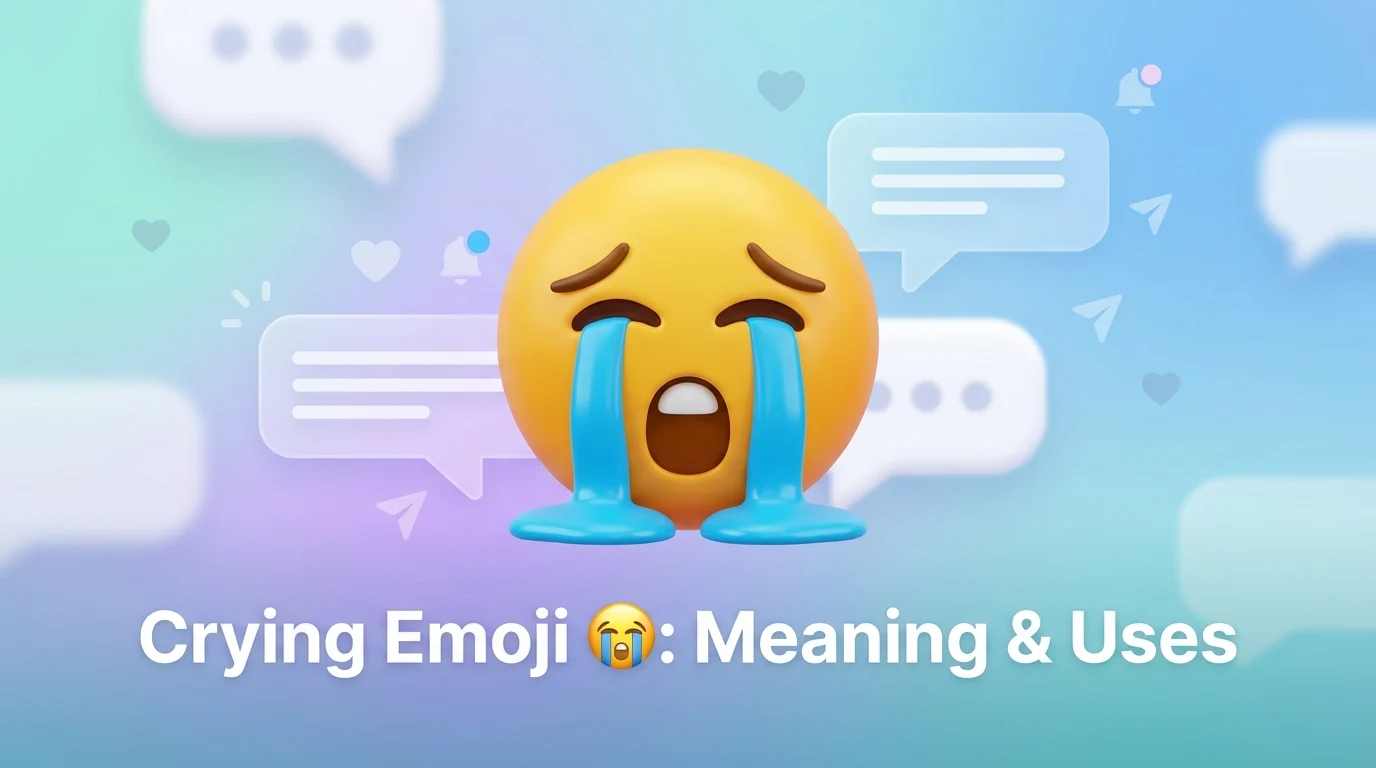
The crying emoji 😭 is commonly known as the Loudly Crying Face. It shows a face with tears streaming from its eyes and is designed to communicate a strong emotional reaction.
Unlike a simple sad expression, 😭 suggests that the emotion is powerful or difficult to contain.
Basic meaning
The emoji can communicate:
- Deep sadness
- Emotional pain
- Disappointment
- Frustration
- Overwhelming feelings
- Intense laughter
- Embarrassment
- Dramatic reactions
Because emojis do not have one fixed meaning in every conversation, the surrounding text is important.
Example
“I can’t believe you are leaving 😭”
Here, 😭 emphasizes sadness and makes the message more emotional.
Another example:
“You really posted that picture of me 😭”
In this situation, it could communicate embarrassment or playful frustration rather than genuine crying.
When Should You Use the Crying Emoji?
The crying emoji works best when you want to add strong emotion to a message. It is especially common in informal conversations with friends, family members, classmates, and social media followers.
1. To Show Genuine Sadness
One of the most straightforward uses is expressing sadness.
Example:
“I really miss my best friend 😭”
The emoji reinforces the emotional meaning of the sentence.
2. To Show Emotional Pain
People sometimes use 😭 when something emotionally hurts them.
Example:
“That ending broke my heart 😭”
Here, the emoji makes the emotional reaction stronger.
3. To Express Frustration
The emoji can also represent frustration when something goes wrong.
Example:
“I studied all night and still got the question wrong 😭”
The person may not literally be crying. Instead, 😭 emphasizes how frustrating the situation feels.
4. To Show Extreme Laughter
This is one of the most common modern uses of 😭.
Example:
“You actually said that in front of everyone 😭”
The person may be laughing so hard that they feel overwhelmed.
5. To React Dramatically
Online conversations often use exaggeration for humor. In these situations, 😭 can make a reaction playful and dramatic.
Example:
“My favorite restaurant is closed today 😭”
The person may be disappointed but is intentionally exaggerating the situation for humor.
Crying Emoji 😭 vs. Other Sad and Emotional Emojis
Not every crying or emotional emoji communicates exactly the same feeling. Choosing the right one can make your message clearer.
| Emoji | Common meaning | Emotional intensity | Typical use |
|---|---|---|---|
| 😢 | Sadness | Moderate | Disappointment or sadness |
| 😭 | Intense emotion | High | Deep sadness, laughter, frustration |
| 🥹 | Emotional or touched | Moderate | Gratitude, happiness, sentimental moments |
| 😿 | Sadness | Moderate | Cute or sympathetic sadness |
| 😥 | Sadness or worry | Moderate | Concern, regret, disappointment |
| 😂 | Strong laughter | High | Something is extremely funny |
| 🤣 | Extreme laughter | Very high | Something is hilariously funny |
The important difference is that 😭 is much more flexible than many people realize. It can be serious, humorous, dramatic, or affectionate depending on the situation.
What Does 😭 Mean in Texting?
In texting, 😭 is often used as an emotional reaction rather than a literal statement that someone is crying.
For example:
“You remembered my birthday 😭”
This could mean the person is touched or genuinely emotional.
“Why would you send me this meme 😭”
This probably means the meme is extremely funny.
“I have an exam tomorrow and haven’t studied 😭”
Here, it expresses stress, panic, or frustration.
Texting has made emoji meanings more flexible. People often use facial emojis as emotional punctuation, similar to how exclamation marks or capital letters add emphasis.
What Does 😭 Mean on Social Media?
On social media, the crying emoji is frequently used in comments, captions, replies, and direct messages.
Its meaning can change depending on the type of content.
Funny posts
If someone comments:
“I can’t stop watching this 😭”
they probably mean the content is extremely funny.
Emotional posts
If someone writes:
“This story made me cry 😭”
the emoji likely indicates genuine sadness or emotional sensitivity.
Cute content
Someone might write:
“Look at that tiny puppy 😭”
In this case, the emoji can communicate overwhelming affection or cuteness.
Embarrassing content
A person may comment:
“Why did I do that 😭”
This can express embarrassment, regret, or humorous self-criticism.
How to Tell What 😭 Means in a Conversation
Because 😭 has several meanings, context is the best way to understand it.
Look at these factors:
Consider the words
The words before the emoji usually provide the strongest clue.
“My grandmother passed away 😭”
Clearly communicates grief.
But:
“This comedian is killing me 😭”
probably expresses laughter.
Consider the topic
A serious conversation usually gives the emoji a serious meaning. A meme or joke often gives it a humorous meaning.
Consider the relationship
Friends may use 😭 playfully with each other. In a formal conversation, the same emoji may appear inappropriate or overly casual.
Look at repeated emojis
Messages such as:
“NOOOO 😭😭😭”
usually communicate a very strong reaction.
Repeated emojis often increase emotional intensity.
Common Phrases Used With the Crying Emoji
People frequently combine 😭 with short phrases and internet expressions.
Examples include:
- “I can’t 😭”
- “No way 😭”
- “Stoppp 😭”
- “I’m crying 😭”
- “This is too funny 😭”
- “Why me 😭”
- “I miss you 😭”
- “That’s so cute 😭”
- “I’m done 😭”
- “Please 😭”
- “Not again 😭”
- “I can’t believe this 😭”
These expressions do not always mean literal crying. Often, they simply communicate an exaggerated emotional reaction.
Crying Emoji Examples in Everyday Conversations
Here are some realistic examples showing how the meaning changes with context.
Sadness
Person A: “Our dog passed away today.”
Person B: “I’m so sorry 😭”
Here, 😭 communicates sympathy and sadness.
Laughter
Person A: “I accidentally called my teacher ‘Mom.’”
Person B: “HAHAHA 😭”
Here, it indicates intense amusement.
Frustration
Person A: “My internet stopped working while I was submitting my assignment.”
Person B: “Nooo 😭”
The emoji expresses frustration and sympathy.
Excitement
Person A: “You got tickets to the concert!”
Person B: “I’M GOING 😭”
The emoji represents overwhelming excitement rather than sadness.
Affection
Person A: “Look what I bought for you.”
Person B: “You are so sweet 😭”
Here, 😭 suggests being emotionally touched.
Is the Crying Emoji Always Negative?
No. This is one of the biggest misunderstandings about 😭.
The emoji visually represents crying, but its digital meaning can be positive, negative, or humorous.
It can communicate:
- Negative emotions such as sadness and disappointment
- Positive emotions such as excitement and affection
- Humorous reactions such as uncontrollable laughter
- Neutral-to-playful reactions such as dramatic exaggeration
For this reason, you should not interpret 😭 by itself. Read the complete message before deciding what the sender means.
Common Mistakes and Misunderstandings
Mistake 1: Assuming 😭 Always Means Sadness
Although crying traditionally represents sadness, online communication has expanded its meaning.
Better approach: Check the surrounding words and conversation.
Mistake 2: Using It in Every Message
Too many emotional emojis can make communication difficult to understand.
For example:
“Okay 😭 Thank you 😭 See you tomorrow 😭”
Unless there is a specific emotional reason, repeated use can make the message confusing.
Mistake 3: Using 😭 in Serious Professional Messages
In casual communication, the emoji can be perfectly natural. In formal emails, academic communication, or professional messages, it may appear too informal.
Instead, clearly state the emotion in words.
Mistake 4: Confusing 😭 With 😢
Both can represent sadness, but 😭 generally suggests stronger or more dramatic emotion.
Mistake 5: Assuming Every User Means the Same Thing
Emoji meanings vary between individuals, age groups, online communities, and cultures.
The safest approach is to interpret the emoji within its specific context.
Tips for Using 😭 Naturally
If you want your messages to sound natural, keep these simple tips in mind:
- Use 😭 when your reaction feels emotionally strong.
- Let the surrounding text explain the emotion.
- Use it casually with people who understand your communication style.
- Remember that it can represent laughter as well as sadness.
- Avoid relying on it when the situation requires precise communication.
- Use other emojis when they better match your intended emotion.
- Consider the relationship between you and the recipient.
- In professional settings, words are usually clearer than emojis.
Why Has 😭 Become So Popular Online?
Digital communication removes many facial expressions and vocal cues that people naturally use during face-to-face conversations.
An emoji helps replace some of that emotional information.
The crying emoji is especially popular because it can communicate a reaction quickly. Instead of writing:
“This is so funny that I don’t know how to respond.”
someone might simply write:
“😭”
Its flexibility also makes it useful for memes, jokes, emotional posts, reactions, and everyday conversations.
Frequently Asked Questions About the Crying Emoji 😭
1. What does the crying emoji 😭 mean?
The crying emoji 😭 usually represents intense sadness, emotional pain, frustration, or overwhelming feelings. Online, it can also mean extreme laughter, excitement, embarrassment, or affection.
2. Does 😭 mean laughing?
Sometimes. In casual internet language, people frequently use 😭 to show that something is extremely funny. Context determines whether the emoji represents actual sadness or humorous laughter.
3. What is the difference between 😢 and 😭?
😢 generally represents ordinary sadness or disappointment, while 😭 usually communicates a stronger and more dramatic emotional reaction.
4. Can 😭 mean happiness?
Yes. Someone may use 😭 when they are extremely happy, excited, touched, or grateful. For example, “I finally got the job 😭” can express overwhelming happiness.
5. What does 😭 mean from a friend?
It depends on the conversation. A friend might use it to express sadness, laughter, frustration, embarrassment, excitement, or dramatic exaggeration.
6. Is the crying emoji appropriate for professional messages?
Usually, it is better avoided in formal professional communication unless you already have a very casual relationship with the recipient. Clear words are generally safer in business or academic settings.
7. Why do people use 😭 after funny comments?
The emoji can symbolize laughing so hard that someone feels emotionally overwhelmed. It has become a popular informal way to react to very funny content.
8. What does “I’m crying 😭” mean online?
“I’m crying 😭” often means “This is extremely funny” or “I am overwhelmed by this reaction.” It does not necessarily mean the person is literally crying.
Conclusion
The crying emoji 😭 is much more versatile than its appearance suggests. While it can represent genuine sadness and emotional pain, people also use it to communicate laughter, frustration, excitement, embarrassment, affection, and dramatic reactions.
The key to understanding 😭 is context. Pay attention to the words, topic, relationship, and overall tone of the conversation. When used appropriately, this simple emoji can add emotion and personality to digital communication without requiring a long explanation.

I’m Adrian Michael, a passionate writer who loves creating fun, clever, and memorable pickup lines. I enjoy helping readers flirt confidently, start conversations, and make meaningful connections.