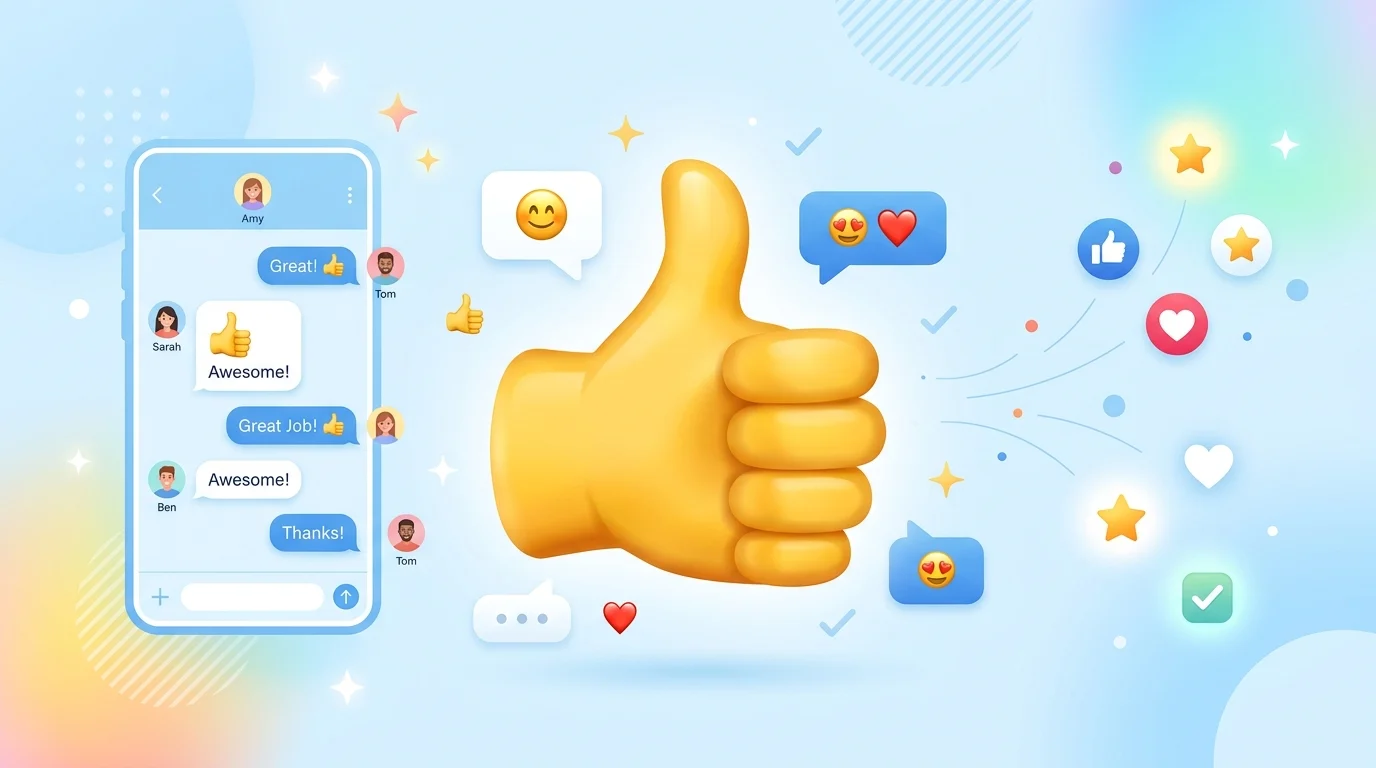
The 👍 thumbs up emoji is one of the most recognizable symbols used in digital communication. It usually means “good,” “okay,” “yes,” “I agree,” “well done,” or “I approve.” Because it is short and easy to understand, people use the thumbs up emoji in text messages, social media comments, work chats, online communities, and everyday conversations.
However, the meaning of 👍 can change depending on the situation, the relationship between the people communicating, and the message around it. In some conversations, it feels friendly and supportive. In others, especially very short replies, it can sound cold, dismissive, or even passive-aggressive.
This guide explains what the thumbs up emoji means, how to use it correctly, when it may be misunderstood, its Unicode information, skin-tone variations, and examples you can use in real conversations.
Quick Answer:
The 👍 thumbs up emoji generally represents:
- Approval
- Agreement
- Acceptance
- “Okay”
- “Yes”
- Support
- Satisfaction
- Encouragement
- Confirmation
- “Good job”
- “Sounds good”
For example:
Person A: “I’ll send you the document tonight.”
Person B: “👍”
Here, the emoji most likely means “Okay” or “Sounds good.”
The official Unicode character is U+1F44D, named “THUMBS UP SIGN.” It was approved in Unicode 6.0 in 2010 and later included in Emoji 1.0 in 2015.
What Is the 👍 Thumbs Up Emoji?
The thumbs up emoji shows a hand with the thumb pointing upward. It is the digital version of the familiar real-world thumbs-up gesture.
The basic emoji is:
👍
You can copy and paste it anywhere that supports emoji.
The Unicode Consortium identifies the character as U+1F44D THUMBS UP SIGN. Unicode provides the underlying character standard, while individual platforms and operating systems decide how the emoji actually looks on their devices.
This is why the same 👍 emoji may look slightly different on an iPhone, Android phone, Windows computer, social media platform, or messaging application.
👍 Thumbs Up Emoji Meaning
The most common meaning of 👍 is approval.
It can communicate a complete thought without using words. Depending on the conversation, it can mean:
1. “Okay”
If someone gives you information or asks you to do something, 👍 can simply mean that you understand.
Example:
“Meeting starts at 10 a.m. tomorrow.”
“👍”
Meaning: “Okay, understood.”
2. “I agree”
The emoji can show agreement with someone’s opinion or suggestion.
Example:
“Let’s take the earlier train.”
“👍”
Meaning: “I agree.”
3. “Good job”
A thumbs up can also be encouraging.
Example:
“You finished the project ahead of schedule.”
“👍 Great work!”
Here, it expresses approval and praise.
4. “Sounds good”
In casual conversations, 👍 often replaces the phrase “sounds good.”
Example:
“I’ll call you after dinner.”
“👍”
Meaning: “Sounds good.”
5. “Yes”
When someone asks a simple question, the emoji can function as an informal yes.
Example:
“Are you coming with us?”
“👍”
Meaning: “Yes.”
What Does 👍 Mean in Texting?
In texting, the thumbs up emoji is usually a quick way to acknowledge a message.
It can mean:
- “Got it.”
- “Okay.”
- “Sure.”
- “Yes.”
- “I understand.”
- “I agree.”
- “No problem.”
- “Thanks.”
- “All right.”
The exact meaning depends heavily on the conversation.
For example:
“Can you bring some water?”
“👍”
This probably means “Sure.”
But:
“I’m really sorry about what happened.”
“👍”
may feel strange or emotionally inappropriate because the situation calls for a more thoughtful response.
This is one reason emojis should be interpreted in context rather than treated as having only one fixed meaning.
Is 👍 a Positive Emoji?
Yes. In most situations, 👍 is a positive or neutral-positive emoji.
It commonly communicates approval, agreement, encouragement, or acknowledgment. Unicode’s related keywords include ideas such as “good,” “like,” “yes,” and “up.”
However, positive does not always mean friendly.
A single thumbs up can sometimes appear emotionally distant, particularly when someone expects a detailed answer.
For example:
“I finally passed my exam after studying for six months!”
Replying only:
“👍”
could seem less enthusiastic than:
“That’s amazing! Congratulations! 🎉👍”
The emoji itself has not changed meaning. The context and amount of emotional effort have changed how it may be received.
Can 👍 Be Sarcastic?
Yes. The thumbs up emoji can sometimes be interpreted as sarcastic, passive-aggressive, or dismissive. Emojipedia also notes that this is possible even though the emoji remains widely used sincerely to express approval.
For example:
“Great, another three-hour meeting. 👍”
Here, 👍 is probably not genuine praise. The surrounding words make the sarcasm clear.
Another example:
“You deleted the file I needed. 👍”
This could express frustration rather than approval.
The safest approach is to consider the sender’s usual communication style and the surrounding text.
👍 vs 👎: What Is the Difference?
The thumbs up and thumbs down emojis are direct opposites.
| Emoji | Common meaning | Typical use |
|---|---|---|
| 👍 | Approval | Yes, good, agree, okay |
| 👎 | Disapproval | No, bad, disagree |
| 👌 | Okay/perfect | Confirmation or satisfaction |
| 🙌 | Celebration | Excitement or congratulations |
| 👏 | Applause | Praise or appreciation |
| ❤️ | Love/care | Affection or strong appreciation |
The 👎 thumbs down emoji generally communicates disapproval, making it the clearest opposite of 👍.
Still, these meanings are not absolute. People can use almost any emoji humorously or sarcastically.
👍 Thumbs Up Emoji Skin Tone Variations
The thumbs up emoji is available with different skin-tone modifiers.
Common versions include:
- 👍 — Thumbs Up
- 👍🏻 — Thumbs Up: Light Skin Tone
- 👍🏼 — Thumbs Up: Medium-Light Skin Tone
- 👍🏽 — Thumbs Up: Medium Skin Tone
- 👍🏾 — Thumbs Up: Medium-Dark Skin Tone
- 👍🏿 — Thumbs Up: Dark Skin Tone
These versions are created by combining the thumbs up emoji with a skin-tone modifier. Supported devices display the combination as a single emoji.
The choice of skin tone is generally a matter of personal preference or representation. Not every device or application necessarily displays every emoji combination in exactly the same way.
How to Use 👍 in Everyday Conversations
The thumbs up emoji works particularly well when the expected response is short.
In casual texting
“I’ll be there in 10 minutes.”
“👍”
When confirming plans
“Let’s meet at 6?”
“👍”
When acknowledging information
“Your package should arrive tomorrow.”
“👍 Thanks.”
When agreeing
“I think we should start early.”
“👍 I agree.”
When encouraging someone
“I’m going to give the presentation today.”
“You’ve got this! 👍”
Adding words can make the intended emotion clearer when a simple emoji might seem too brief.
Using 👍 at Work
The thumbs up emoji is now common in workplace messaging, especially in informal team chats. It can be useful for quickly acknowledging information or confirming that you have seen a message.
For example:
“The report has been uploaded.”
“👍”
Or:
“Can everyone join the call at 2 p.m.?”
“👍”
However, workplace culture differs. In a formal email, writing “Thank you, I’ve received it” may be more appropriate than sending only an emoji.
In professional communication, use 👍 when the environment already accepts casual messages and emoji reactions.
When Should You Avoid the 👍 Emoji?
Although the thumbs up emoji is versatile, it is not appropriate for every situation.
Consider using words instead when:
- Someone is sharing serious or emotional news.
- You need to explain an important decision.
- A customer needs detailed assistance.
- A manager is communicating a sensitive workplace issue.
- Someone has asked a complicated question.
- Your response could easily be interpreted as dismissive.
For example, if a friend says:
“I’m having a really difficult day.”
A better response would be something like:
“I’m sorry you’re dealing with that. Do you want to talk?”
rather than simply:
“👍”
The goal is not to avoid emojis. It is to match the response to the emotional importance of the message.
👍 in Social Media and Online Communities
The thumbs up symbol is widely used as a quick reaction to posts, comments, and messages.
A person may use 👍 to indicate:
- They like an idea.
- They agree with a statement.
- They support a suggestion.
- They have read something.
- They approve of an action.
- They want to acknowledge a comment.
Many messaging and social platforms provide emoji reactions, and 👍 is commonly included among reaction choices.
This makes the emoji particularly useful when users want to react without writing a full reply.
Common Misunderstandings About 👍
“It always means yes.”
Not necessarily.
It can mean yes, but it can also mean “okay,” “got it,” “good,” or simply “I saw your message.”
“A thumbs up is always friendly.”
Usually, but not always.
A short 👍 can sometimes sound cold or sarcastic depending on context.
“The emoji looks identical everywhere.”
No.
Emoji designs are created by individual platforms and can vary in appearance. Unicode standardizes the character, not one universal artwork.
“👍 and 👌 mean exactly the same thing.”
Not quite.
👍 generally emphasizes approval or agreement, while 👌 more often means “okay,” “perfect,” or “all good.”
Tips for Using the Thumbs Up Emoji Naturally
If you want your message to be clear and friendly, keep these tips in mind:
- Use 👍 for simple confirmations.
- Add words when the topic is important or emotional.
- Consider your relationship with the person.
- Pay attention to the tone of the conversation.
- Use additional emojis when you want stronger emotion.
- Avoid relying on 👍 to answer complicated questions.
- Remember that sarcasm can change its interpretation.
- Use the skin-tone version that feels appropriate to you.
A simple emoji works best when the message itself is simple.
Why Is the 👍 Emoji So Popular?
The biggest advantage of 👍 is its simplicity.
Instead of typing “Okay, I understand,” a person can send one character. Instead of writing “I agree,” they can react with 👍. This saves time while still communicating a recognizable idea.
It also works across many languages because the underlying gesture is visually understandable. Unicode’s emoji annotations associate 👍 with concepts such as “good,” “like,” “yes,” and “up.”
Its usefulness has made it a common reaction and conversational shortcut in digital communication.
Copy and Paste the 👍 Thumbs Up Emoji
Want to copy it?
👍
You can copy the emoji above and paste it into:
- Messenger
- X
- TikTok
- Discord
- Slack
- Text messages
- Emails that support emoji
- Online comments
You can also use the skin-tone versions when supported by your device.
Frequently Asked Questions
1. What does the 👍 thumbs up emoji mean?
The 👍 thumbs up emoji usually means approval, agreement, acceptance, “okay,” “yes,” “good,” or “sounds good.” Its exact meaning depends on the conversation.
2. Is 👍 a positive emoji?
Yes. It is generally positive or neutral-positive and is commonly used to show approval, support, agreement, or acknowledgment.
3. Can 👍 mean “okay”?
Yes. In texting, 👍 is frequently used as a quick way of saying “okay,” “got it,” or “sounds good.”
4. Can the thumbs up emoji be sarcastic?
Yes. In certain situations, 👍 can sound sarcastic or passive-aggressive. The surrounding words and the relationship between the people communicating are important.
5. What is the Unicode code for 👍?
The Unicode code point for the thumbs up emoji is U+1F44D, and its Unicode character name is THUMBS UP SIGN.
6. Does 👍 have different skin tones?
Yes. The thumbs up emoji can be combined with different skin-tone modifiers, producing versions such as 👍🏻, 👍🏼, 👍🏽, 👍🏾, and 👍🏿.
7. Is 👍 appropriate for professional messages?
It can be appropriate in informal workplace chats when emoji reactions are accepted. For formal emails, sensitive topics, or detailed requests, words are usually clearer.
8. What is the difference between 👍 and 👎?
👍 normally expresses approval, agreement, or acceptance, while 👎 normally expresses disapproval or disagreement. They are commonly used as positive and negative reactions.
Conclusion
The 👍 thumbs up emoji is a simple but powerful part of modern digital communication. Most often, it means approval, agreement, confirmation, or “okay.” It can make short conversations faster and works especially well when a simple acknowledgment is all that is needed.
At the same time, 👍 is not completely universal in tone. A single thumbs up may feel friendly in one conversation but cold or sarcastic in another. The best way to use it is to consider the situation, relationship, and emotional tone before sending it. When the subject is important or sensitive, adding a few words is usually the clearest choice.

I’m Adrian Michael, a passionate writer who loves creating fun, clever, and memorable pickup lines. I enjoy helping readers flirt confidently, start conversations, and make meaningful connections.