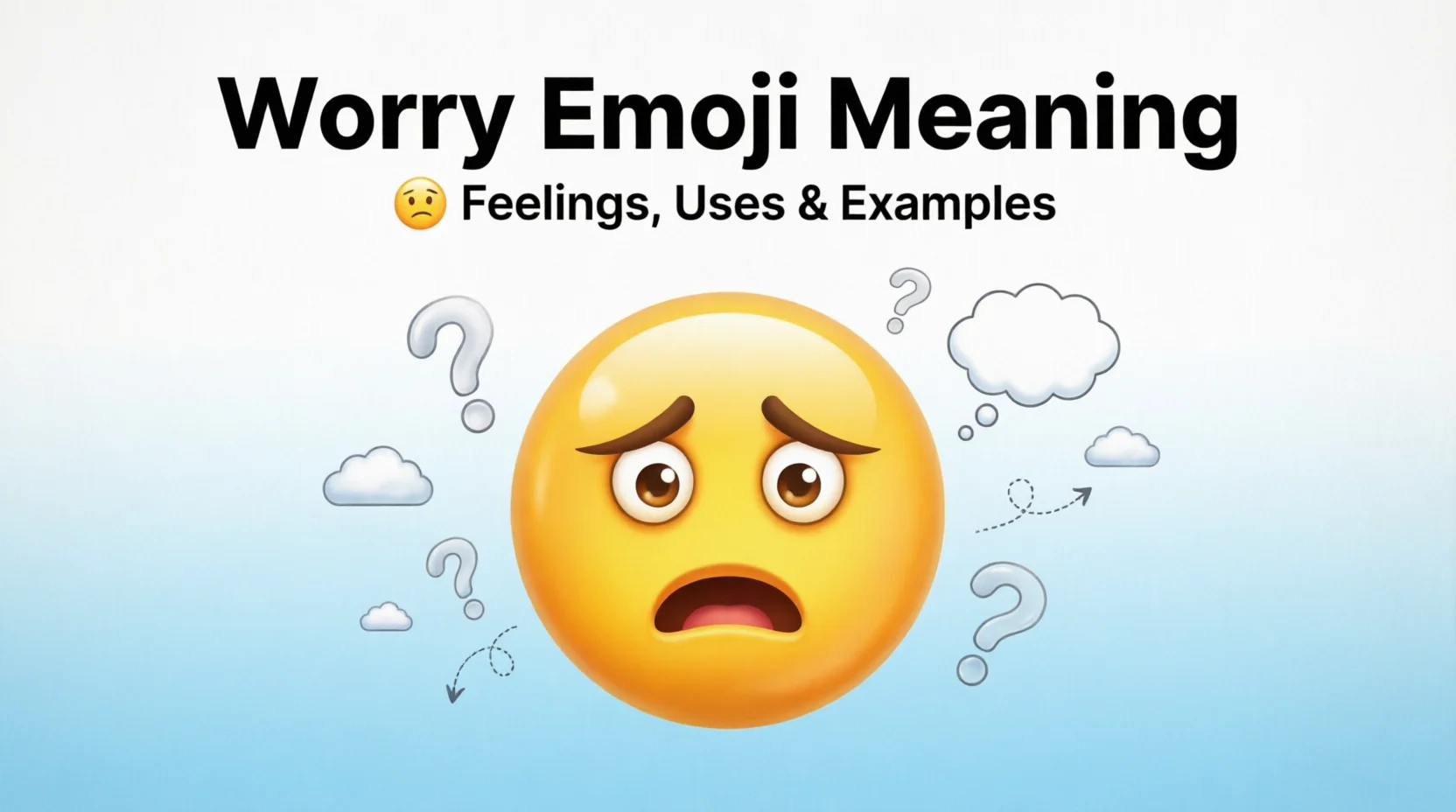
The worry emoji 😟 is commonly used to express concern, nervousness, sadness, or uneasiness about a situation. It helps people show that something is bothering them, that they feel uncertain about an outcome, or that they are worried about someone they care about. Other emojis, such as 😰, 😨, 😕, and 😥, can also communicate worry, depending on the emotion and context.
If you are sending a WhatsApp message, writing an Instagram caption, or replying to a friend, the right worry emoji can make your feelings easier to understand. However, not every worried-looking emoji means exactly the same thing. This guide explains the meaning of the worry emoji, its differences from similar emojis, real-life examples, and the best combinations to use in 2026.
Quick Answer: What Does the Worry Emoji 😟 Mean?
The 😟 emoji is officially known as the Worried Face. It typically represents concern, anxiety, uneasiness, or sadness about something that may happen or has already happened.
People commonly use it when they are:
- Worried about a friend or family member.
- Nervous about an exam, interview, or important decision.
- Concerned about unexpected news.
- Unsure about what will happen next.
- Disappointed or troubled by a situation.
Example: “I hope everything goes well tomorrow 😟.”
In this message, the emoji communicates nervousness and concern about the outcome. Its precise meaning depends on the words surrounding it and the conversation between the people involved.
What Is the Meaning of the Worry Emoji?
😟
Emoji name: Worried Face
Main meaning: Concern, worry, uneasiness, or emotional discomfort.
Common uses: Personal messages, difficult situations, uncertain outcomes, and expressions of sympathy.
Emotional tone: Concerned, troubled, or slightly sad.
The 😟 emoji has a frowning mouth and raised, inward-slanting eyebrows that give it a troubled expression. It can communicate that someone is thinking about a problem or feeling uneasy about something.
For example, imagine your friend tells you that they have an important job interview tomorrow. You could respond, “I hope it goes well 😟.” Depending on your relationship and the surrounding conversation, this could show concern or nervousness.
The emoji does not automatically mean that someone is experiencing severe anxiety. It can represent anything from a small concern to a more serious worry.
Different Emotions Expressed by 😟
Although the worried face has a central meaning, people use it in several related situations.
1. Concern for Someone
You might use 😟 when a friend is sick, a family member is facing a problem, or someone has shared difficult news.
Example: “You haven’t been feeling well lately. I hope you’re okay 😟.”
Here, the emoji expresses care and concern.
2. Nervousness About the Future
The worried face is also suitable when you do not know how something will turn out.
Example: “My results come out tomorrow 😟.”
It suggests uncertainty and nervous anticipation.
3. Disappointment or Sadness
Sometimes, worry and sadness occur together. The emoji can show disappointment when a plan fails or an unexpected problem appears.
Example: “The trip might get cancelled because of the weather 😟.”
4. Feeling Uncomfortable
You can use 😟 when a situation feels awkward, difficult, or unpleasant.
Example: “That conversation made me uncomfortable 😟.”
5. Seeking Reassurance
A worried emoji may encourage another person to offer comfort or explain what is happening.
Example: “You said we need to talk. Is everything okay? 😟”
However, emojis can be interpreted differently by different people, so it is best to use clear words when a situation is important.
Worry Emoji vs. Other Worried Emojis
Several emojis can communicate concern, fear, sadness, or nervousness. Choosing the right one helps you express the exact feeling you want to convey.
😟
Worried Face
Best for general concern, uneasiness, and troubling thoughts.
Example: “I’m worried about the meeting 😟.”
😰
Anxious Face with Sweat
Often suggests intense nervousness, stress, or relief after a difficult situation.
Example: “I almost missed my exam 😰.”
😨
Fearful Face
More strongly associated with fear, alarm, or being frightened by something.
Example: “I heard a strange noise outside 😨.”
😥
Sad but Relieved Face
Can express sadness, disappointment, or worry mixed with relief.
Example: “That was a difficult day, but it’s finally over 😥.”
😕
Confused Face
Better suited to confusion, uncertainty, or mild dissatisfaction than strong worry.
Example: “I’m not sure what you mean 😕.”
These interpretations are common rather than absolute. A person may use 😨 for an unexpected bill or 😟 for a serious concern. The accompanying message provides important context.
When Should You Use the Worry Emoji?
The 😟 emoji works well in personal conversations, casual messages, and social media posts when you want to communicate concern without writing a long explanation.
| Situation | Example Message | Why It Fits |
| Exam stress | “I hope I pass tomorrow 😟.” | Shows nervous anticipation |
| Family concern | “Dad hasn’t called yet 😟.” | Expresses concern for someone |
| Job interview | “My interview is in an hour 😟.” | Communicates uncertainty |
| Unexpected news | “I wasn’t expecting that update 😟.” | Shows that something is troubling |
| Cancelled plans | “Looks like we may not be able to go 😟.” | Expresses disappointment |
| Difficult decision | “I’m still not sure what to choose 😟.” | Shows uncertainty |
| Friend in trouble | “Is everything okay? 😟” | Communicates care and concern |
| Waiting for results | “The results should arrive soon 😟.” | Shows nervousness about the outcome |
You can also use the emoji in a short response when someone shares concerning information. For instance, “Oh no, what happened? 😟” shows that you are paying attention and want to understand the situation.
Best Worry Emoji Combinations
Combining 😟 with another emoji can communicate a more specific feeling. Here are some useful combinations for messages, captions, and status updates.
😟💭
Worrying thoughts
For overthinking or being concerned about something.
“Can’t stop thinking about tomorrow 😟💭”
Copy
😟❤️
Concern and love
For expressing care about a loved one’s situation.
“I just want you to be okay 😟❤️”
Copy
😟🙏
Hope and concern
For hoping that a difficult situation improves.
“Hoping for good news today 😟🙏”
Copy
😟💔
Emotional pain
For worry connected with heartbreak or disappointment.
“I didn’t expect things to turn out this way 😟💔”
Copy
😟⏳
Waiting anxiously
For waiting for a reply, decision, or result.
“Still waiting for the final answer 😟⏳”
Copy
😟🤞
Worried but hopeful
For hoping things work out despite uncertainty.
“Fingers crossed for tomorrow 😟🤞”
Copy
Worry Emoji for WhatsApp Messages
On WhatsApp, 😟 is useful when you want to show concern, ask a question gently, or tell someone that you are feeling uncertain.
Here are some copy-ready messages:
- “Are you okay? You seem quiet today 😟”
- “I hope everything goes well for you 😟❤️”
- “I’m a little worried about the results 😟”
- “Please let me know when you get home safely 😟”
- “I hope it’s nothing serious 😟🙏”
- “You haven’t replied in a while. Is everything okay? 😟”
- “I really hope we can solve this problem 😟”
- “Waiting for your response 😟⏳”
When you are messaging someone about a serious issue, use the emoji to support your words rather than replace them. For example, “I’m concerned about you. Can we talk?” communicates your feelings more clearly than sending 😟 alone.
Worry Emoji for Instagram Captions and Stories
Instagram users often use emojis to express emotions in short captions, stories, and posts. The worried face can fit posts about uncertainty, stressful days, disappointing news, or personal challenges.
Short Worry Captions
- Too many thoughts today 😟💭
- Hoping for better news 🙏😟
- Waiting and wondering ⏳😟
- Not sure what comes next 😟
- One of those difficult days 😟💔
- Trying to stay hopeful 🤞😟
- Some things are hard to explain 😟
- Keeping my fingers crossed 🤞
Emotional Captions
- Sometimes the hardest part is not knowing what happens next 😟💭
- Trying to stay positive even when things feel uncertain 😟❤️
- I hope tomorrow brings the answers I’m waiting for 🙏
- Behind every smile, there can be a lot of thoughts 😟💭
Use these captions to express a mood without revealing more personal information than you want to share. If a post concerns another person, consider their privacy before sharing details about their situation.
How to Reply When Someone Sends 😟
If someone sends you the worried face, they might be expressing concern, nervousness, disappointment, or uncertainty. The best response depends on the conversation.
| Their Message | Possible Reply |
| “My exam is tomorrow 😟” | “You’ve prepared for it. Do your best!” |
| “I’m waiting for the results 😟” | “I hope you get good news soon.” |
| “Something went wrong today 😟” | “I’m sorry. What happened?” |
| “I’m worried about you 😟” | “Thank you for caring. I’ll let you know.” |
| “I don’t know what to do 😟” | “Let’s talk through your options together.” |
| “My friend isn’t answering 😟” | “I understand why you’re concerned. Have you tried calling?” |
A supportive reply usually works better than immediately telling someone not to worry. First, acknowledge their feelings. Then, if appropriate, offer reassurance or practical help.
For example, “That sounds stressful. Do you want to talk about it?” makes room for an honest conversation without assuming you already know what is wrong.
Common Mistakes When Using the Worry Emoji
Even a simple emoji can be misunderstood when the context is unclear.
1. Confusing Worry With Fear
The 😟 emoji usually expresses concern or uneasiness, while 😨 more strongly suggests fear or alarm. Although the meanings can overlap, they are not interchangeable in every situation.
2. Using It When You Mean Confusion
If you do not understand a message, 😕 may be a better fit. Use 😟 when you want to communicate concern rather than simple confusion.
3. Sending Only an Emoji in a Serious Conversation
A single 😟 may leave the other person wondering what you mean. Add a short explanation when you are discussing health, safety, relationships, or important decisions.
4. Assuming Someone Is in Crisis
Receiving 😟 does not prove that someone is experiencing a serious emotional problem. They may simply be nervous about a test, deadline, or everyday situation. Ask what is wrong instead of making assumptions.
5. Overusing Worried Emojis
Repeatedly sending 😟😟😟😟 may make a message seem more intense than you intended. One emoji paired with clear wording is usually sufficient.
Practical Tips for Using 😟 Correctly
- Match the emotion: Use 😟 for concern, 😨 for fear, and 😕 for confusion when those distinctions fit your message.
- Consider your relationship: A close friend may understand your emoji immediately, while a colleague may need a few explanatory words.
- Add context: “I’m worried about the meeting 😟” is clearer than sending the emoji alone.
- Use combinations carefully: Pair 😟 with 💭 for worrying thoughts or ❤️ to express care.
- Avoid making assumptions: If someone sends you a worried face, ask how they feel rather than guessing.
- Remember that displays vary: Emoji artwork can look slightly different on different phones, apps, and operating systems.
- Choose clarity for serious matters: For urgent concerns, explain the situation directly instead of relying on emojis.
FAQs:
1. What is the official name of 😟?
The 😟 emoji is called the Worried Face. It is commonly used to express concern, uneasiness, nervousness, or sadness.
2. What does 😟 mean from a girl?
If a girl sends 😟, she may be worried, concerned, disappointed, or nervous about something. However, the emoji alone cannot tell you exactly how she feels. Consider the conversation and ask politely if you are unsure.
3. What does 😟 mean from a boy?
A boy using 😟 may be expressing concern, uncertainty, or worry about a situation. It does not have a different official meaning based on who sends it.
4. What is the difference between 😟 and 😰?
😟 generally represents worry or concern, while 😰 often communicates stronger anxiety, nervousness, or stress. Their meanings overlap, and the surrounding message helps determine the intended emotion.
5. Is 😟 a sad emoji or a worried emoji?
It is primarily known as the Worried Face, but it can also convey sadness or disappointment. People sometimes feel several of these emotions at once, which is why interpretations can overlap.
6. Can I use 😟 to show that I care about someone?
Yes. You can use it when someone shares difficult news or when you want to show concern. For example, “I hope you’re feeling better 😟❤️” combines worry with affection.
7. What emojis go well with 😟?
Common combinations include 😟💭 for worrying thoughts, 😟❤️ for concern and affection, 😟🙏 for hope, and 😟⏳ for waiting anxiously. Choose the combination that matches your message.
8. How do I copy the worry emoji?
You can copy this symbol directly: 😟. Select it, copy it, and paste it into WhatsApp, Instagram, TikTok, or another app that supports emojis.
Conclusion
The worry emoji 😟 is a simple and recognizable way to express concern, nervousness, uncertainty, or emotional discomfort. It is useful in personal conversations, WhatsApp messages, Instagram captions, and everyday discussions when something is troubling you or you care about another person’s situation. Although it can overlap with sadness or fear, its main purpose is to communicate a worried or uneasy feeling.
To use the Worried Face effectively, consider the situation, choose relevant emoji combinations, and add words when your message needs more clarity. If you are waiting for important news, supporting a friend, or sharing an uncertain moment, 😟 can help communicate your feelings in a natural and relatable way.

I’m Connor James, an administrator at FlirtyLinz, passionate about pickup lines, playful conversations, dating, and helping readers find fun, confident, and creative ways to start conversations.