“And then” is a common English expression used to show what happens next in a sequence of events. It connects actions, ideas, or events by explaining their order in time. For example, “I finished my homework, and then I watched TV.” In this sentence, finishing homework happens first, and watching TV happens afterward. Understanding and then usage helps students, English learners, writers, and everyday speakers communicate more clearly and naturally.
Although “and then” looks simple, it can be confusing when compared with “then,” “and,” and “after that.” Each expression has a slightly different purpose. This guide explains the meaning, grammar rules, sentence patterns, examples, and common mistakes so you can use “and then” correctly in everyday English.
Quick Answer: How Do You Use “And Then”?
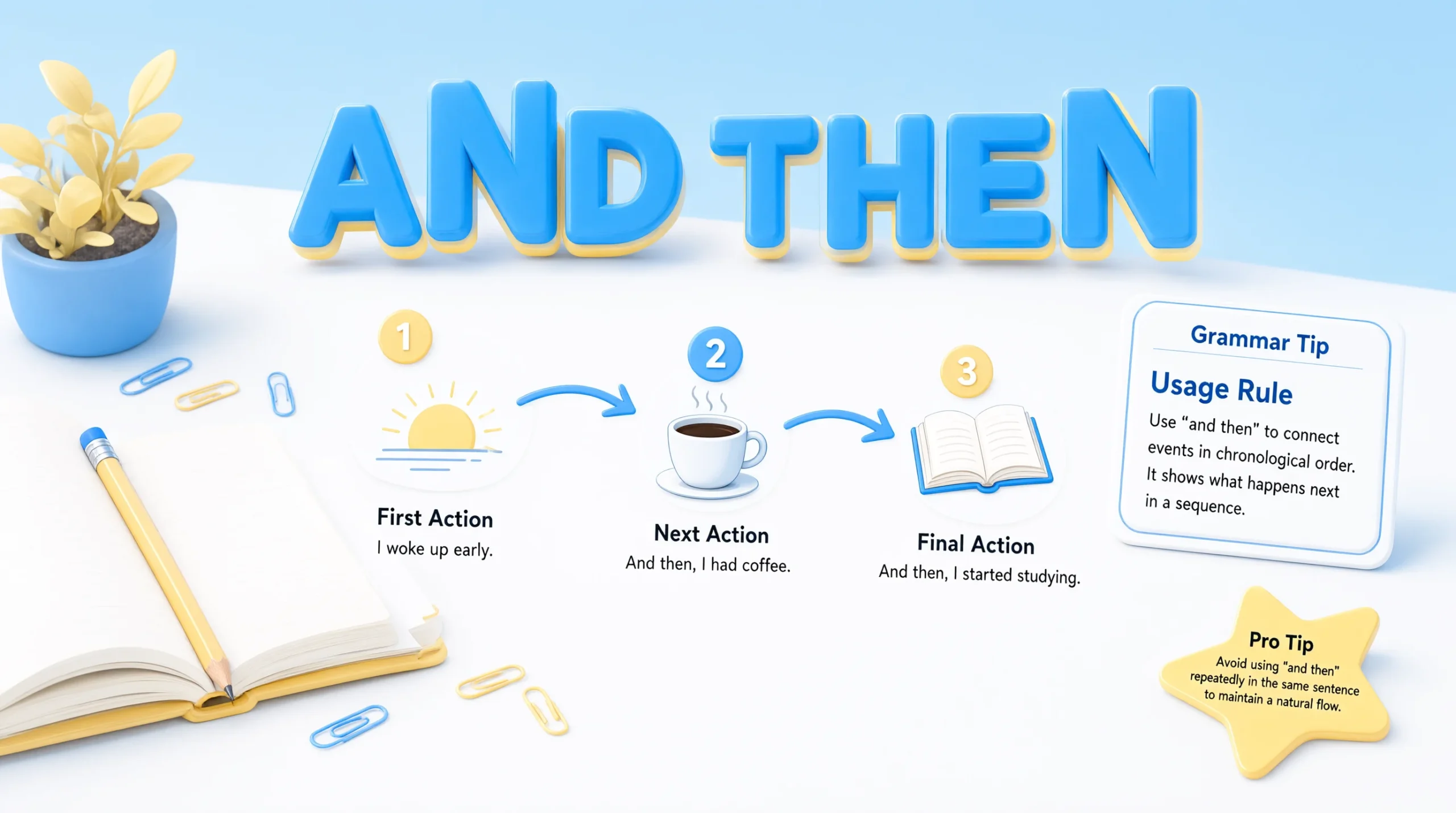
Use “and then” to connect two events or actions that happen one after another. The first action usually happens before the second action.
Examples:
- I woke up, and then I took a shower.
- She opened the door, and then she walked inside.
- We had dinner, and then we watched a movie.
- Finish your work, and then you can relax.
The expression is especially useful when telling stories, giving instructions, describing routines, and explaining a sequence of events.
What Does “And Then” Mean?
“And then” combines two familiar words: “and” and “then.”
- And connects words, phrases, or clauses.
- Then indicates what happens next or what follows in time.
Together, they commonly mean “and after that” or “and next.”
For example:
“I went to the market, and then I bought some fruit.”
The sentence describes two events in chronological order:
- I went to the market.
- I bought some fruit.
The expression makes the relationship between the events clear. It tells the reader or listener that the second event follows the first.
However, “and then” does not always mean that the second event happens immediately. Some time may pass between the two events.
Example: “I graduated from college, and then I started my first job.”
The events happen in sequence, but they may be separated by days, weeks, or months.
Main Rules for “And Then” Usage
Understanding a few basic rules will help you use this expression correctly.
1. Use “And Then” to Show Sequence
The most common use is to describe actions in the order they happen.
Examples:
- He got dressed, and then he left the house.
- I turned on my computer, and then I opened my email.
- They arrived at the station, and then they bought their tickets.
- She studied for the exam, and then she went to bed.
In each sentence, the first action comes before the second.
2. Use “And Then” to Tell Stories
When telling a story, “and then” helps your audience follow the events.
Example:
“Yesterday, I went to the park. I met an old friend, and then we sat together and talked for an hour.”
The phrase guides the listener from one event to the next.
You can use it in personal stories, conversations, essays, and informal writing. However, avoid repeating it in every sentence because too much repetition can make a story sound monotonous.
3. Use “And Then” in Instructions
“And then” is useful when explaining the steps needed to complete a task.
Examples:
- Add the sugar, and then stir the mixture.
- Open the app, and then enter your password.
- Wash the vegetables, and then cut them into small pieces.
- Read the question carefully, and then choose your answer.
This usage is common in recipes, tutorials, classroom instructions, and technical guides.
4. Use “And Then” to Describe Daily Routines
You can use the expression to explain what you usually do during the day.
Examples:
- I wake up at six, and then I go for a walk.
- She finishes her classes, and then she studies at home.
- We eat breakfast, and then we leave for work.
- He checks his messages, and then he starts his assignments.
For repeated habits, you can use the simple present tense. For completed events in the past, use the simple past.
5. Use “And Then” With Different Verb Tenses
“And then” does not require one particular verb tense. The tense depends on the meaning of the sentence.
| Tense | Example | Purpose |
| Simple present | I eat breakfast, and then I go to work. | Routine or habit |
| Simple past | I ate breakfast, and then I went to work. | Completed past events |
| Simple future | I will finish this task, and then I will call you. | Future sequence |
| Present perfect + future | I have finished my work, and then I will take a break. | Possible, though “now that I have finished my work, I will take a break” is often more natural |
| Past continuous + past simple | I was walking home, and then it started raining. | An ongoing past action followed by another event |
Remember that the expression itself does not determine the tense. The verbs should match the time and meaning you want to communicate.
How to Use “And Then” in Different Sentence Positions
“And then” most often appears between two actions or clauses, but it can also appear at the beginning of a sentence.
1. In the Middle of a Sentence
This is the most common pattern.
Structure: First action + and then + second action.
Examples:
- I completed my assignment, and then I submitted it.
- She called her mother, and then she went shopping.
- We visited the museum, and then we ate lunch.
- He locked the door, and then he went to sleep.
This structure is particularly useful when both actions belong to the same story or sequence.
2. At the Beginning of a Sentence
You can begin a sentence with “And then” when continuing a story or adding the next event.
Examples:
- And then, something unexpected happened.
- And then we realized we had taken the wrong road.
- And then the lights suddenly went out.
- And then everyone started laughing.
Starting with “And then” is common in conversation and storytelling. In formal writing, use it thoughtfully to maintain a clear flow rather than beginning every sentence the same way.
3. In Spoken English
People often use “and then” while explaining something spontaneously.
Examples:
- “First, we went shopping, and then we grabbed some lunch.”
- “I opened the file, and then I noticed the mistake.”
- “We were talking, and then he suddenly left.”
In casual speech, speakers sometimes use “and then” repeatedly as they remember events. In polished writing, combining related actions or varying transition words usually sounds better.
“And Then” vs. “Then” vs. “After That”
These expressions are similar, but they are not always interchangeable in every sentence.
| Expression | Meaning | Example |
| And then | Connects an event to what follows | I ate lunch, and then I went outside. |
| Then | Indicates what happens next | I ate lunch. Then I went outside. |
| After that | Refers to something that happens following an earlier event | I ate lunch. After that, I went outside. |
| Next | Identifies the following step or event | First, wash the rice. Next, add water. |
| Afterwards | Means at a later time | We watched a film and went for dinner afterwards. |
| Subsequently | Means later, often in formal contexts | The company subsequently changed its policy. |
When Should You Use “And Then”?
Use it when you want to connect two related actions in one sentence.
Example: “I packed my bag, and then I left for school.”
When Should You Use “Then”?
Use “then” when the next event can stand alone in a separate sentence.
Example: “I packed my bag. Then I left for school.”
When Should You Use “After That”?
Use “after that” when referring back to a previously mentioned event, especially in explanations or longer descriptions.
Example: “I packed my bag. After that, I checked the bus schedule.”
All three options can be correct. Your choice depends on sentence structure, emphasis, and writing style.
“And Then” in Questions
Although “and then” is most common in statements, it also appears naturally in questions.
People use it to ask what happened next, what someone plans to do afterward, or what the next step should be.
Examples:
- What happened, and then what did you do?
- You finished your homework, and then what?
- What should I do first, and then what comes next?
- If I submit the application today, what happens then?
In everyday conversation, “And then what?” is a particularly common question. It asks someone to continue explaining a sequence of events.
Example:
Person A: “I went to the office and spoke to the manager.”
Person B: “And then what happened?”
Person B wants to know the next event in the story.
“And Then” in Conditional Sentences
“And then” can also describe what happens after a condition is met or an action is completed.
Examples:
- If you finish your homework, and then you clean your room, you can go outside.
- Submit the form, and then wait for confirmation.
- If the weather improves, we will go hiking, and then we will have lunch nearby.
The first example is grammatically possible in some contexts but can sound awkward because the condition and the sequence are not clearly organized. A more natural version is:
“If you finish your homework and clean your room, you can go outside.”
This illustrates an important point: although “and then” is useful, it should not be inserted into every sentence containing two actions.
For clear instructions, you can write:
“First, finish your homework. Then clean your room.”
For a future sequence, you can write:
“If the weather improves, we will go hiking and then have lunch nearby.”
Practical Examples of “And Then” Usage
Here are examples from common situations to help you understand how the expression works in everyday English.
Everyday Life
- I brushed my teeth, and then I went to bed.
- She made coffee, and then she read the newspaper.
- We cleaned the house, and then we invited our friends over.
- He took a shower, and then he got dressed.
School and Education
- The teacher explained the lesson, and then the students completed an exercise.
- I read the chapter, and then I answered the questions.
- She prepared her notes, and then she revised for the exam.
- We discussed the topic, and then we wrote a summary.
Work and Business
- I checked my emails, and then I attended the meeting.
- The manager reviewed the report, and then she approved it.
- We collected the data, and then we analyzed the results.
- He finished the presentation, and then he sent it to the team.
Travel and Transportation
- We reached the airport, and then we checked in.
- They boarded the train, and then they found their seats.
- I booked a hotel, and then I planned the rest of my trip.
- We visited the beach, and then we drove back to the hotel.
Future Plans
- I will finish this book, and then I will start another one.
- She will call you, and then you can discuss the details.
- We will complete the project, and then we will celebrate.
- He will save enough money, and then he will buy a car.
Common Mistakes in “And Then” Usage
Even though “and then” is easy to understand, learners sometimes use it incorrectly or unnecessarily.
Mistake 1: Repeating “And Then” Too Often
Incorrect or awkward style:
“I woke up, and then I ate breakfast, and then I got dressed, and then I left.”
This is understandable, but it sounds repetitive.
Better:
“I woke up, ate breakfast, got dressed, and left.”
Alternatively:
“I woke up and ate breakfast. Then I got dressed and left.”
Mistake 2: Using “And Then” When the Events Are Not Sequential
“And then” normally suggests that one event follows another.
Awkward: “I like reading, and then my brother likes swimming.”
The two ideas do not describe a sequence.
Better: “I like reading, and my brother likes swimming.”
Use “and” to connect related information that does not need a time relationship.
Mistake 3: Confusing “And Then” With “Than”
“And then” and “than” sound similar to some English learners, but their meanings differ.
- Then: Refers to time, sequence, or a result.
- Than: Is used in comparisons.
Examples:
- “I finished my work, and then I went home.”
- “She is taller than her brother.”
Writing “and than” when you mean “and then” is a spelling and grammar mistake.
Mistake 4: Using the Wrong Verb Tense
Incorrect: “Yesterday, I eat lunch, and then I go to school.”
Correct: “Yesterday, I ate lunch, and then I went to school.”
Because the sentence describes completed past events, the simple past tense is appropriate.
Mistake 5: Adding Unnecessary Words
Awkward: “I finished my homework, and then after that I watched TV.”
The expressions “and then” and “after that” perform a similar sequencing function here.
Better: “I finished my homework, and then I watched TV.”
Or: “I finished my homework. After that, I watched TV.”
Practical Tips for Using “And Then” Correctly
Use these strategies to make your English more natural and clear.
- Think about the order of events. Use “and then” when one action follows another.
- Choose the correct tense. Use past tense for completed past events and appropriate future forms for future plans.
- Avoid unnecessary repetition. Combine simple actions when the sequence is already clear.
- Use alternative transitions. Try “next,” “after that,” or “afterwards” when they fit the context.
- Read your sentence aloud. If the sentence sounds repetitive, remove an unnecessary transition.
- Keep instructions organized. Use “first,” “next,” and “finally” when explaining several steps.
- Do not confuse sequence with addition. Use “and” alone when you are simply connecting two facts.
Mini Practice: Choose the Correct Expression
Test your understanding with these examples.
1. I finished dinner, ___ I washed the dishes.
and then
than
2. My sister is older ___ me.
and then
than
3. First, open the document. ___, click the Save button.
Then
Than
Try again
FAQs:
1. What is the meaning of “and then” in English?
“And then” usually means “and after that” or “and next.” It connects events that happen in sequence, such as “I ate breakfast, and then I went to work.”
2. Is “and then” grammatically correct?
Yes. “And then” is grammatically correct when used appropriately to connect related events or actions. For example, “She finished her assignment, and then she submitted it.”
3. Can you start a sentence with “and then”?
Yes. You can begin a sentence with “And then” when continuing a story or adding another event. For example, “And then the phone suddenly rang.” This is especially common in conversational and narrative writing.
4. What is the difference between “then” and “and then”?
“Then” can introduce the next event in a separate sentence, while “and then” commonly connects the next event to an earlier clause. Both can express sequence.
5. Should I put a comma before “and then”?
When “and then” connects two independent clauses, a comma before “and” is generally appropriate: “I finished my work, and then I went home.” If it connects shorter elements or phrases, the comma may not be necessary.
6. Can “and then” be used in formal writing?
Yes. It is grammatically acceptable in formal writing, particularly when explaining a process or sequence. However, transitions such as “subsequently” or “thereafter” may be preferable in some formal contexts.
7. Is “and then after that” correct?
It can occur in conversation, but it is usually unnecessarily repetitive because both expressions indicate what happens next. Prefer “and then” or “after that” for clearer writing.
8. What are some alternatives to “and then”?
Common alternatives include “then,” “next,” “after that,” “afterwards,” “later,” and “subsequently.” Choose the expression that best fits the sentence, level of formality, and intended time relationship.
Conclusion
Understanding “and then” usage helps you describe events, tell stories, explain instructions, and communicate everyday activities more naturally. The expression usually connects two actions that happen one after another, as in “I finished my homework, and then I watched TV.” It works with different verb tenses, and it can appear in the middle of a sentence or at the beginning of a new one.
To improve your English, practice using “and then” in daily conversations and short paragraphs. Remember to use the correct verb tense, avoid unnecessary repetition, and distinguish “then” from “than.” With regular practice, you will learn when “and then” sounds natural and when another transition makes your sentence clearer.

I create fun, creative pickup lines and flirty messages that help people feel confident, spark conversations, and make their chats more playful, memorable, and enjoyable.