Have you ever wondered if to say “on the platform” or “in the platform”? Both expressions can be grammatically correct, but they are used in different situations. In everyday English, “on the platform” usually refers to using a digital service, standing on a physical platform, or participating in a public space. “In the platform” is less common and usually refers to something inside a system, structure, or platform environment. The correct choice depends on what you mean and how the word “platform” is being used.
In this guide, you will learn the difference between “on the platform” and “in the platform,” explore practical examples, understand common mistakes, and discover how to choose the right preposition in everyday conversations, academic writing, and professional communication.
Quick Answer: On the Platform vs. In the Platform
Use “on the platform” when talking about using a website, social media service, or public digital space, or when referring to a physical platform’s surface.
Use “in the platform” when emphasizing something contained within a platform’s internal system, structure, or environment.
| Expression | Main Meaning | Example |
| On the platform | Using a service or standing on a surface | “I shared the video on the platform.” |
| In the platform | Inside a system or its internal environment | “The error is in the platform’s software.” |
Easy rule: Use “on” for participation, access, or a surface. Use “in” for an interior, contained environment, or internal component.
However, this is a general guideline rather than an absolute rule. The intended meaning and the type of platform matter.
What Does “On the Platform” Mean?
The phrase “on the platform” is widely used in modern English. It can refer to a digital service, a public communication space, or a physical raised surface.
1. Using a Digital Platform
When people talk about websites, apps, and online services, they commonly use “on the platform.”
Examples:
- I posted a new video on the platform.
- You can find the course on the platform.
- She has thousands of followers on the platform.
- The company sells its products on the platform.
- We discussed the issue on the platform yesterday.
In these examples, the platform is treated as a service where activities take place.
This usage is common with social media websites, online marketplaces, learning management systems, and content-sharing services.
For example, you would normally say:
- “I uploaded a photo on Instagram.”
- “The course is available on the learning platform.”
- “You can advertise your products on the marketplace.”
2. Standing on a Physical Platform
The phrase also describes a person or object positioned on the surface of a physical platform.
Examples:
- The speaker stood on the platform.
- The train passengers waited on the platform.
- The workers placed the equipment on the platform.
- The singer performed on the stage platform.
Here, “on” indicates a position on a surface.
This meaning is especially common when discussing railway stations, stages, construction sites, and raised structures.
3. Participating in a Public Space
A platform can also mean a place where people share opinions, express ideas, or communicate with an audience.
Examples:
- She spoke on a public platform about education.
- The organization raises awareness on digital platforms.
- He shared his opinion on the platform.
- Artists use online platforms to reach new audiences.
In these sentences, the phrase emphasizes participation or communication rather than physical location.
What Does “In the Platform” Mean?
“In the platform” is less common than “on the platform” when referring to digital services. However, it can be correct when the sentence emphasizes an internal part, contained environment, or component.
1. Referring to Internal Software or Technology
In technical writing, “in the platform” can refer to something occurring within a platform’s software environment.
Examples:
- There is a problem in the platform’s payment module.
- The developer found a bug in the platform.
- A new feature is available in the platform’s administrative interface.
- The team identified a security issue in the platform’s internal system.
These examples focus on the platform’s internal operation rather than simply using the service.
Nevertheless, the most natural wording can depend on the sentence. For instance, “There is a bug in the platform” is natural, while “I uploaded a video in the platform” usually sounds less natural in general English.
2. Referring to Something Contained Within a Structure
A platform may have internal sections, components, or spaces. In those contexts, “in” can describe something located within the structure.
Examples:
- The wiring is concealed in the platform’s structure.
- A sensor is installed in the platform.
- The software stores configuration settings in the platform’s internal database.
These sentences emphasize containment or internal placement.
3. Describing an Internal Environment
Sometimes, “platform” refers to an integrated technological environment with tools, features, and connected systems.
Examples:
- Users can manage their accounts in the platform’s administration area.
- The developer configured the application in the platform’s development environment.
- The error occurs in the platform’s reporting system.
In many of these cases, adding a more specific noun makes the sentence clearer. For example, “in the platform’s reporting system” tells readers exactly where the problem occurs.
What Is the Main Difference Between “On” and “In”?
The difference comes from how English uses prepositions to express relationships between objects, places, and activities.
“On” often describes a surface, a medium, or participation in a service.
“In” often describes an interior, a contained space, or something that exists within a system.
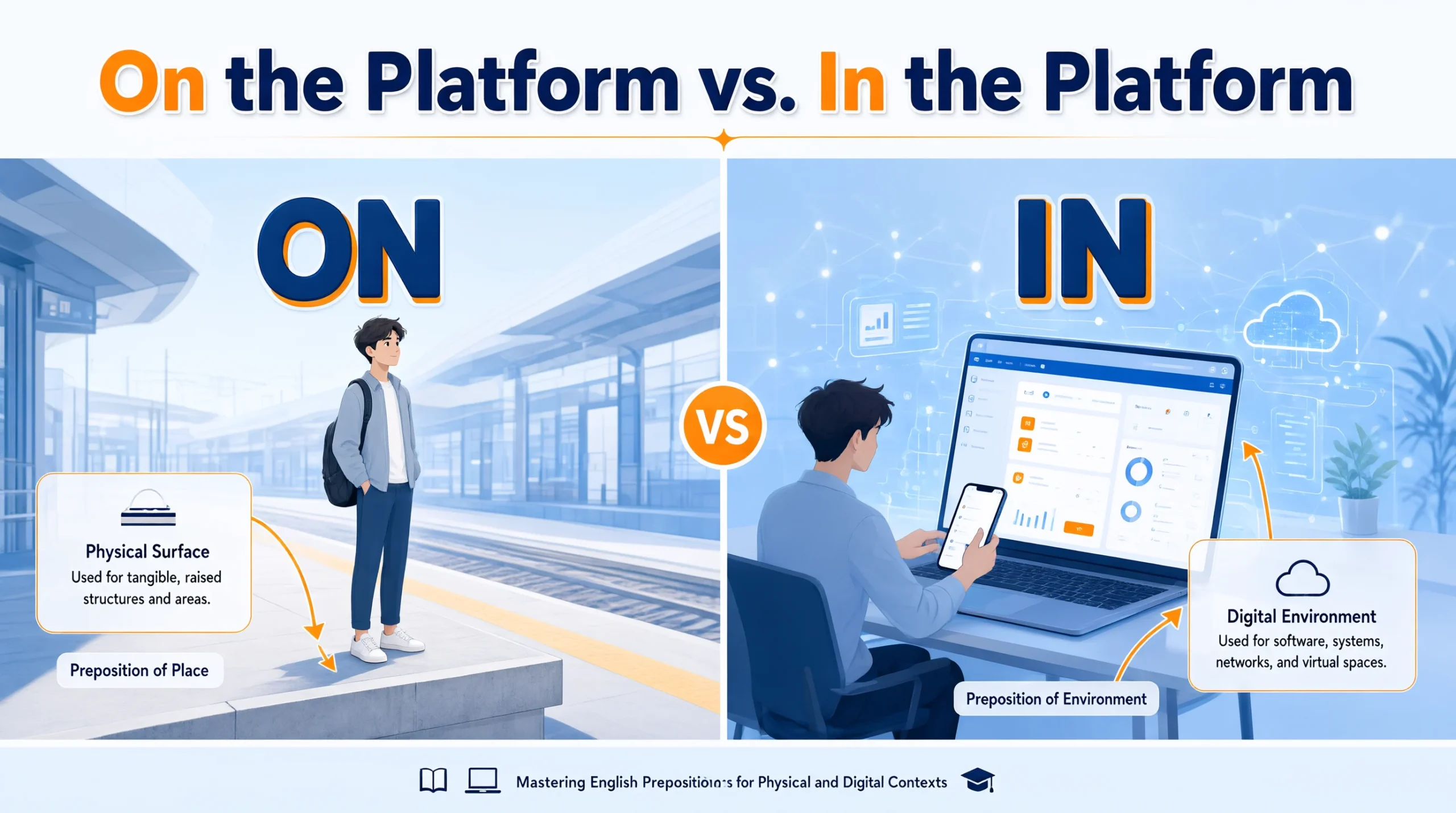
ON
Surface, service, or participation
Use “on” when you mean using an online service, publishing content, or standing on a physical surface.
Example: “The announcement appeared on the platform.”
IN
Interior, containment, or internal operation
Use “in” when emphasizing an internal component, enclosed area, or part of a system.
Example: “The error is in the platform’s database.”
The distinction is not always physical. English speakers also use “on” and “in” according to established language conventions. That is why “on a website” is standard even though a website is not a physical surface.
On the Platform vs. In the Platform: Examples
The following examples show how the intended meaning affects the choice of preposition.
| Incorrect or Less Natural | Better Expression | Explanation |
| I posted a photo in the platform. | I posted a photo on the platform. | Posting content is usually described with “on.” |
| She has an account in the platform. | She has an account on the platform. | Accounts are commonly associated with services using “on.” |
| The passengers waited in the platform. | The passengers waited on the platform. | The sentence refers to the platform’s surface. |
| There is a bug on the platform’s database. | There is a bug in the platform’s database. | The problem exists within the database. |
| I found the feature on the platform’s software. | I found the feature in the platform’s software. | “In” emphasizes the software environment. |
| The company launched its service in the platform. | The company launched its service on the platform. | The service is being offered through the platform. |
Notice that the first column does not contain universally incorrect English. Some phrases can be grammatical in a different context. The better expressions are the more natural choices for the intended meanings shown here.
More Everyday Examples
Using “on the platform”:
- The teacher uploaded the assignment on the platform.
- We announced the event on the platform.
- You can follow the brand on the platform.
- The train is waiting on the platform.
- I completed the course on the platform.
Using “in the platform”:
- A technical error exists in the platform’s code.
- The settings are stored in the platform’s database.
- The problem occurs in the platform’s internal workflow.
- A component is missing in the platform’s structure.
- The developers made changes in the platform’s configuration system.
Some technical writers may prefer “within the platform” for greater precision, especially when describing a system’s internal operations.
Should You Say “On a Platform” or “In a Platform” for Websites and Apps?
For most everyday conversations about websites and apps, “on the platform” is the safer and more natural choice.
Examples:
- I found this product on the platform.
- The teacher shared the lesson on the platform.
- We communicate with customers on the platform.
- The business has a store on the platform.
- The new feature is available on the platform.
However, “in the platform” can also occur in technical or specialized contexts.
For example:
- The user permissions are configured in the platform.
- The problem exists in the platform’s code.
- The data is processed in the platform’s internal environment.
Even here, the best preposition depends on the precise meaning. Some sentences would sound clearer with a more specific phrase:
- “The user permissions are configured in the platform’s settings.”
- “The problem exists in the platform’s codebase.”
- “The data is processed within the platform’s environment.”
What About “On the Platform” vs. “Within the Platform”?
“Within the platform” is often a useful alternative when you want to emphasize that something happens inside a system rather than simply through the service.
Compare these examples:
- “Customers can purchase products on the platform.” This describes the platform as a service.
- “The application stores customer preferences within the platform.” This emphasizes internal storage.
- “The new policy applies across the platform.” This describes the platform as a whole.
“Within” is not always necessary. In ordinary writing, “in the platform’s database” is clear and natural.
How Does the Meaning Change for Physical Platforms?
When “platform” refers to a physical structure, the distinction is easier to understand.
On the Platform
Use “on” when a person or object rests on the platform’s surface.
Examples:
- The boxes are on the platform.
- The performer stood on the platform.
- The passengers are waiting on the railway platform.
- The machine is positioned on the raised platform.
In the Platform
Use “in” when something is inside the platform’s structure or enclosed space.
Examples:
- The electrical cables are hidden in the platform.
- A support mechanism is installed in the platform.
- The workers found a damaged component in the platform’s interior.
The exact wording depends on the physical design. If the structure is solid and has no meaningful interior, “in the platform” may sound unusual. In that situation, phrases such as “under the platform,” “inside the platform structure,” or “beneath the platform” may be more accurate.
Common Mistakes to Avoid
Understanding the basic difference is helpful, but these common mistakes can still cause confusion.
1. Assuming “On” Always Means a Physical Surface
In English, “on” also describes participation in services and media.
Correct examples:
- I saw the announcement on the website.
- She posted the video on the app.
- We met on the online platform.
None of these requires a literal physical surface.
2. Using “In” for Every Digital Environment
Although software contains internal components, people usually say “on the platform” when discussing general activities.
Less natural: “I sell clothes in the platform.”
More natural: “I sell clothes on the platform.”
However, “in the platform’s inventory system” would be appropriate if the sentence refers specifically to an internal tool.
3. Ignoring the Meaning of the Noun
The correct preposition depends on what follows “platform.”
Compare:
- “The video is on the platform.”
- “The error is in the platform’s video-processing software.”
The first sentence describes where content is available. The second describes where a technical problem exists.
4. Treating Every Alternative as Incorrect
Sometimes, more than one preposition is possible because the speaker is emphasizing a different relationship.
For example, “The information is on the platform” means it is available through the service. “The information is stored in the platform’s database” identifies its internal storage location.
The sentences describe different aspects of the same system.
5. Using Vague Technical Language
“In the platform” can be unclear if the reader does not know which internal component you mean.
Instead of writing “The problem is in the platform,” consider:
- The problem is in the platform’s login system.
- The error occurs in the payment module.
- The data is missing from the reporting dashboard.
Specific wording makes technical explanations easier to understand.
Practical Tips for Choosing the Right Preposition
Use these simple guidelines when writing emails, assignments, reports, or online content.
- Think about the activity. If someone is posting, sharing, selling, or communicating through a service, “on the platform” is usually correct.
- Think about physical location. If something rests on a platform’s surface, use “on.”
- Think about internal components. If you mean a database, codebase, module, or internal structure, “in” may be more suitable.
- Use “within” when it improves clarity. This can be useful in technical writing when describing an internal environment.
- Read the complete sentence. A preposition may be correct grammatically but unnatural for the meaning you want.
- Avoid unnecessary complexity. “The course is on the platform” is often better than a longer, less natural alternative.
A quick test can help: ask yourself whether you mean using the platform as a service or locating something inside its structure or system. The answer will usually guide your choice.
FAQs:
1. Is it correct to say “on the platform”?
Yes. “On the platform” is standard English when referring to a digital service, online marketplace, social media site, or physical platform surface. For example, “I shared the announcement on the platform.”
2. Is “in the platform” grammatically correct?
Yes, in suitable contexts. It can describe something inside a physical structure or an internal software environment. For example, “The error is in the platform’s database.” For general online activities, “on the platform” is usually more natural.
3. Should I say “I uploaded the file on the platform” or “in the platform”?
“I uploaded the file on the platform” is the more common expression in everyday English. You can also say “I uploaded the file to the platform,” which emphasizes the destination of the upload.
4. Why do we say “on a website” instead of “in a website”?
English convention treats a website as a service or medium on which content is published and accessed. Therefore, “on a website” is standard. However, “in a website’s code” is appropriate when referring to its internal code.
5. Is “within the platform” better than “in the platform”?
Not always. “Within the platform” can emphasize an internal system or environment, particularly in technical writing. However, “in the platform’s database” is already natural and precise.
6. What is the difference between “on the platform” and “at the platform”?
“On the platform” often describes a surface or online service. “At the platform” can refer to a location or point of arrival, depending on context, but it is less common when describing the surface itself. For example, “We met at the railway station platform entrance” identifies a meeting location.
7. Can I use “on the platform” in professional writing?
Yes. It is common and appropriate in business, education, technology, and marketing. For example, “The training materials are available on the platform.” Use more specific phrases when describing internal software components.
8. What is the easiest way to remember the difference?
Remember this simple guideline: use “on” for using a service or referring to a surface, and use “in” for an interior or internal component. Then check whether the expression sounds natural in the complete sentence.
Conclusion
The difference between “on the platform” and “in the platform” depends mainly on meaning and context. “On the platform” is generally the best choice when discussing websites, apps, social media services, online courses, and physical surfaces. In contrast, “in the platform” can be correct when describing internal software, databases, structures, or contained environments. Understanding this distinction will help you write clearer, more natural English.
When in doubt, consider what you are trying to describe. If you are sharing content or using an online service, choose “on the platform.” If you are explaining an internal component or something contained within a structure, “in” may be appropriate. For technical explanations, adding a specific noun such as “database,” “software,” or “configuration system” can make your meaning even clearer.

I’m Adrian Michael, a passionate writer who loves creating fun, clever, and memorable pickup lines. I enjoy helping readers flirt confidently, start conversations, and make meaningful connections.