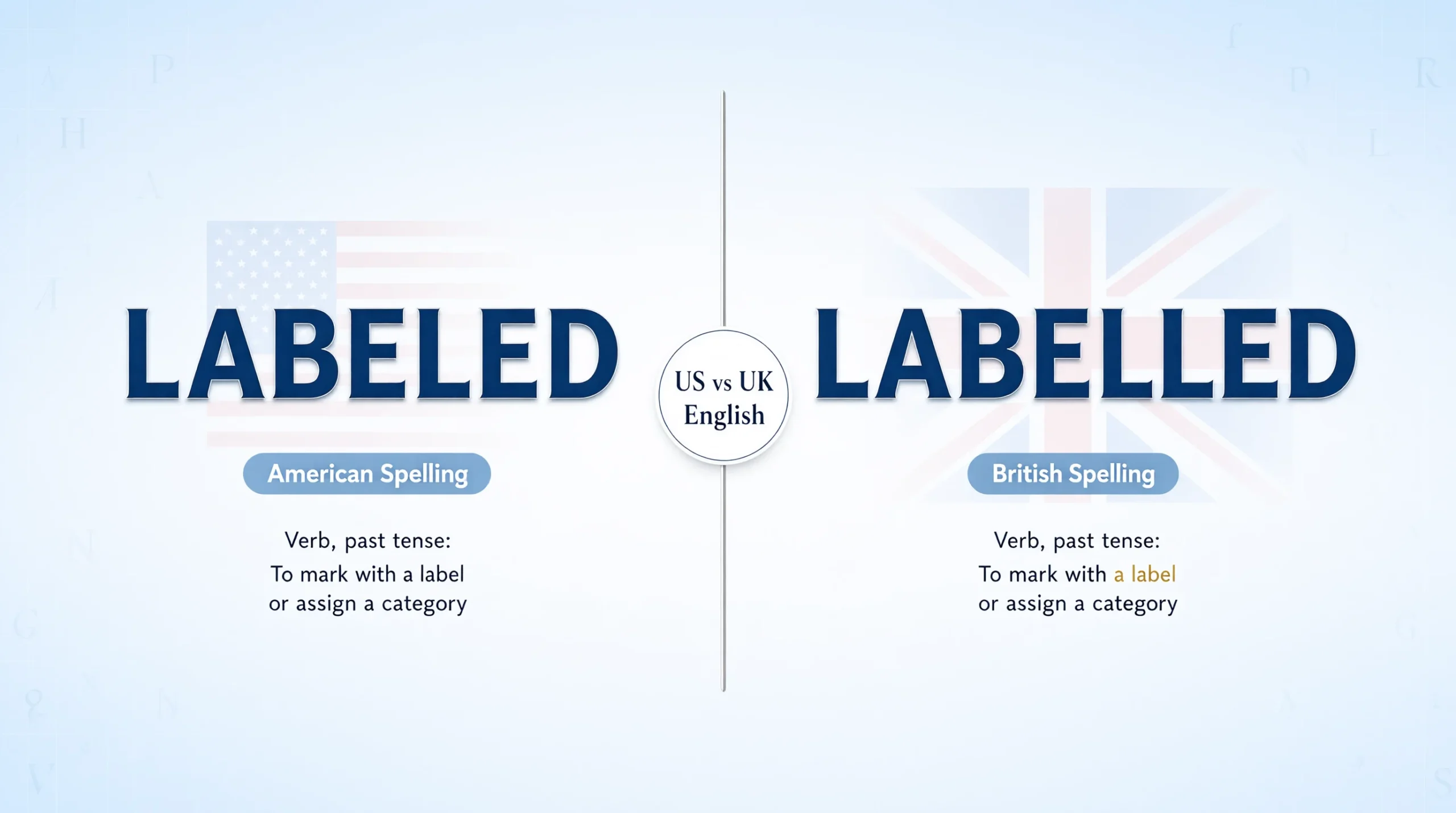
When comparing labeled vs labelled, both spellings are correct. The difference is regional: labeled is the standard spelling in American English, while labelled is the standard spelling in British English. Both words are the past tense and past participle of the verb label, meaning to attach a label to something, identify something, or describe someone or something in a particular way.
For example, an American writer might say, “The box was labeled fragile,” while a British writer might write, “The box was labelled fragile.” Both sentences are grammatically correct and have exactly the same meaning. The only difference is the spelling convention being followed.
Understanding this difference helps students, English learners, writers, and professionals choose the appropriate spelling for their audience. Although the distinction is small, using consistent spelling throughout an essay, email, report, or website makes your writing clearer and more professional.
Quick Answer
Labeled is the American English spelling, while labelled is the British English spelling. Both mean marked, identified, or given a name or description. Use labeled when following American spelling conventions and labelled when following British conventions. Neither spelling is inherently more correct than the other.
Why Do People Confuse Labeled and Labelled?
People often confuse these words because English uses different spelling conventions in different countries. Some words ending in a consonant followed by -ed or -ing require a doubled consonant in British English but not in American English.
The verb label follows this pattern. When adding a suffix, American English generally keeps one l, producing labeled and labeling. British English typically doubles the final l, producing labelled and labelling.
Both forms follow accepted spelling rules within their respective varieties of English.
What Does Labeled Mean?
Labeled is the past tense and past participle of label in American English.
It can describe something that has been marked with a label, identified by a name, or given a particular description.
Examples:
- The teacher labeled each student’s notebook.
- The food containers were labeled with their contents.
- The manager labeled the files by department.
- He was unfairly labeled a troublemaker.
In each sentence, labeled describes an action or a result of identifying or describing someone or something.
What Does Labelled Mean?
Labelled has the same meaning as labeled, but it is the preferred spelling in British English and other varieties that commonly follow British spelling conventions.
Examples:
- The teacher labelled each student’s notebook.
- The food containers were labelled with their contents.
- The manager labelled the files by department.
- He was unfairly labelled a troublemaker.
The meaning does not change when the second l is added. The difference is purely a matter of regional spelling preference.
Labeled vs Labelled: Comparison Table
| Feature | Labeled | Labelled |
| Preferred spelling | American English | British English |
| Meaning | Marked or identified | Marked or identified |
| Part of speech | Verb form | Verb form |
| Base verb | Label | Label |
| Past tense | Labeled | Labelled |
| Past participle | Labeled | Labelled |
| Present participle | Labeling | Labelling |
| Common usage | US publications and writing | UK publications and writing |
| Grammar | Correct | Correct |
| Pronunciation | Same | Same |
Key takeaway: The spelling changes, but the meaning, grammar, and pronunciation remain the same.
When Should You Use Labeled or Labelled?
The best choice depends on your audience and the spelling style you are following.
Use Labeled in American English
Choose labeled when writing for an American audience or following American English conventions.
Common situations include:
- School assignments that require American English.
- Business documents written for US clients.
- American newspapers, blogs, and websites.
- Product descriptions intended for the US market.
- Technical instructions following US spelling standards.
Examples:
- The technician labeled the electrical wires.
- All ingredients must be labeled clearly.
- The researcher labeled each sample before testing.
Use Labelled in British English
Choose labelled when writing for a British audience or following British English conventions.
Common situations include:
- School assignments using British English.
- Reports prepared for UK organizations.
- Publications following British spelling standards.
- Business communication intended for British readers.
- Educational materials using British English.
Examples:
- The technician labelled the electrical wires.
- All ingredients must be labelled clearly.
- The researcher labelled each sample before testing.
What If You Are Writing for an International Audience?
If your readers come from different countries, either spelling can work. However, consistency matters.
Choose one spelling convention and use it throughout your document. For example, if you choose labeled, also use American forms such as color and organize where appropriate. If you choose labelled, British forms such as colour and organise may be more suitable.
12 Examples of Labeled vs Labelled in Sentences
These examples show how both spellings work in everyday English.
| American English | British English |
| The package was labeled correctly. | The package was labelled correctly. |
| She labeled the folders by date. | She labelled the folders by date. |
| The bottles were labeled with names. | The bottles were labelled with names. |
| He labeled the diagram carefully. | He labelled the diagram carefully. |
| The wires were labeled before installation. | The wires were labelled before installation. |
| The teacher labeled the chart. | The teacher labelled the chart. |
| The samples were labeled for testing. | The samples were labelled for testing. |
| They labeled the boxes as fragile. | They labelled the boxes as fragile. |
| The product was labeled incorrectly. | The product was labelled incorrectly. |
| She labeled each drawer. | She labelled each drawer. |
| The file was labeled confidential. | The file was labelled confidential. |
| The behavior was labeled unusual. | The behaviour was labelled unusual. |
Notice that the final example also illustrates another regional difference: behavior is American English, while behaviour is British English.
More Examples in Everyday Contexts
In education: The student labeled the parts of the plant.
In business: Every document was labelled with a reference number.
In science: The laboratory samples were labeled before analysis.
In technology: The developer labeled each component in the diagram.
In everyday conversation: She felt that other people had labelled her unfairly.
These examples demonstrate that both spellings are suitable for physical labels and descriptions of people, ideas, or situations.
Common Mistakes to Avoid
Even though both spellings are correct, writers sometimes make mistakes when using them.
1. Mixing Both Spellings in One Document
Incorrect style:
- The first box was labeled.
- The second box was labelled.
Both sentences are individually correct, but mixing spellings without a reason can make a document inconsistent.
Better approach: Choose either American or British English and use it consistently.
2. Thinking One Spelling Is Grammatically Wrong
Neither spelling is grammatically incorrect. The difference comes from regional spelling conventions, not grammar.
For example, The package was labeled and The package was labelled are both correct.
3. Writing “Lableled” or “Lableled”
The correct forms are labeled and labelled. Do not omit the first e in the base word label.
4. Confusing Labeled With Labeling
The same regional difference applies to the -ing form:
- American English: labeling
- British English: labelling
Remember that the preferred spelling changes according to the variety of English.
5. Forgetting the Word’s Meaning
Labeled and labelled can refer to a physical marking, but they can also describe how someone or something is categorized.
For example, “He was labelled dishonest” means someone described him as dishonest. It does not mean a physical label was attached to him.
Memory Trick: How to Remember the Difference
A simple way to remember the spelling is to connect each form with its region.
- Labeled = American English: one l before -ed.
- Labelled = British English: double ll before -ed.
You can also remember the related forms together:
| American English | British English |
| Labeled | Labelled |
| Labeling | Labelling |
| Traveled | Travelled |
| Traveling | Travelling |
| Canceled | Cancelled |
| Canceling | Cancelling |
This pattern is common in many words, although English spelling rules have exceptions. For that reason, it is best to check a dictionary when you are unsure about a particular word.
American vs British English: Why Is the Spelling Different?
American and British English developed different spelling preferences over time. Both varieties remain standard forms of English, but they do not always spell words in the same way.
One noticeable difference involves verbs ending in a single l. British English often doubles the final l before suffixes such as -ed and -ing, even when the final syllable is unstressed.
American English often keeps a single l in these cases.
For example:
- American: labeled, labeling
- British: labelled, labelling
This distinction also appears in words such as traveled/travelled and canceled/cancelled.
However, the rule is not universal. Some words use double l in both varieties, and other verbs follow different patterns. Therefore, do not assume that every verb ending in l will behave exactly like label.
Similar Words: Labeled vs Other Spellings
Several English words follow similar regional spelling patterns.
Labeled vs Labelled
These are alternative spellings of the same word. Use labeled in American English and labelled in British English.
Labeling vs Labelling
Both words describe the act of adding a label or assigning a description. Labeling is American English, while labelling is British English.
Example: “The team is labeling the boxes” and “The team is labelling the boxes” have the same meaning.
Traveler vs Traveller
Both words refer to someone who travels. Traveler is the standard American spelling, while traveller is the standard British spelling.
Traveled vs Travelled
Both forms are the past tense of travel. Americans generally write traveled, while British writers generally use travelled.
Canceled vs Cancelled
Both spellings are accepted. American English generally prefers canceled, whereas British English generally prefers cancelled.
What About the Noun “Label”?
The noun label is spelled the same way in American and British English.
Examples:
- Please read the label before using the product.
- The label contains the manufacturer’s information.
The spelling difference usually appears when the word is changed into forms such as labeled, labelled, labeling, or labelling.
Final Verdict: Labeled or Labelled?
Both labeled and labelled are correct spellings of the same word. The right choice depends on the English variety you are using.
Choose labeled for American English, including US schoolwork, business writing, and publications. Choose labelled for British English, including writing that follows UK spelling conventions.
Neither spelling changes the meaning or pronunciation of the word. The most important thing is to follow your audience’s expectations and remain consistent throughout your writing.
FAQs:
1. Is labeled or labelled correct?
Both are correct. Labeled is the standard American English spelling, while labelled is the standard British English spelling.
2. Is labelled British English?
Yes. Labelled is the preferred spelling in British English and many contexts that follow British spelling conventions.
3. Is labeled American English?
Yes. Labeled is the standard spelling in American English and is widely used in US publications, educational materials, and professional documents.
4. Do labeled and labelled mean the same thing?
Yes. Both mean marked with a label, identified, or given a name or description. The spelling does not change the meaning.
5. Is labeling or labelling correct?
Both are correct. Use labeling in American English and labelling in British English.
6. Why does British English use two Ls in labelled?
British English commonly doubles the final l in words such as label before adding suffixes like -ed and -ing. American English often retains one l in these forms.
7. Which spelling should I use in academic writing?
Follow the spelling convention required by your school, university, publisher, or style guide. If no specific convention is required, choose one variety of English and apply it consistently.
8. Is “the box was labelled” grammatically correct?
Yes. “The box was labelled” is grammatically correct British English. “The box was labeled” is equally correct in American English.
Remember This
- Labeled = American English.
- Labelled = British English.
- Both spellings have the same meaning and pronunciation.
- Labeling is American; labelling is British.
- Consistency is more important than choosing one regional spelling over the other.
Conclusion
The difference between labeled and labelled is simple once you understand American and British spelling conventions. Both words are correct, and both describe the act of marking, identifying, or giving a name or description to something. The only difference is the extra l in the British spelling.
When writing for American readers, choose labeled. When writing for British readers, choose labelled. If you are writing for an international audience, follow a consistent spelling style that suits your readers. By remembering this small distinction, you can make your English writing clearer, more accurate, and more professional.

I’m Connor James, an administrator at FlirtyLinz, passionate about pickup lines, playful conversations, dating, and helping readers find fun, confident, and creative ways to start conversations.