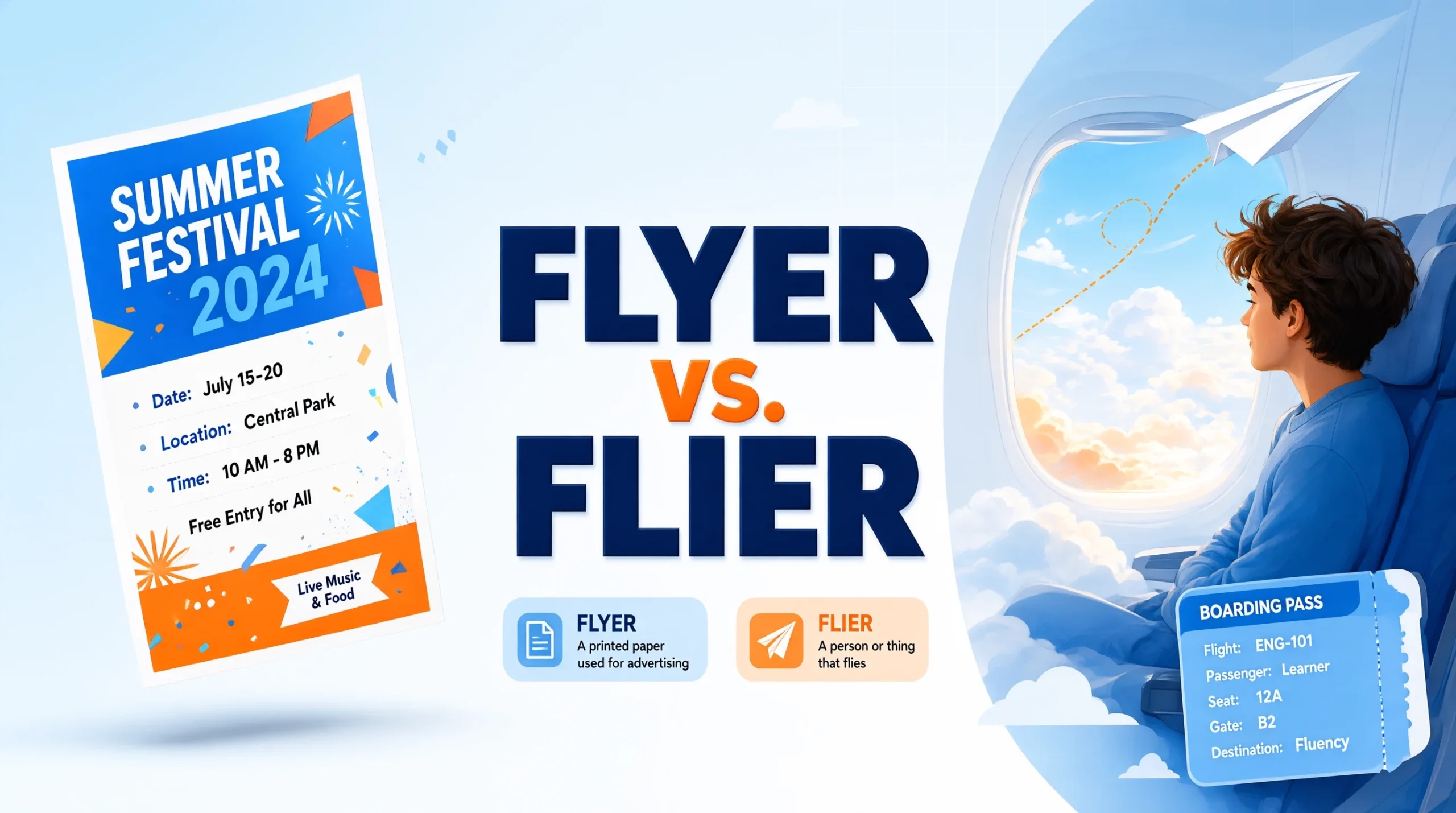
The words flyer vs flier often confuse English learners because both spellings can be correct. In most situations, flyer and flier have the same meaning, but one spelling is more common in certain contexts. Both words can refer to a small printed advertisement, such as a notice promoting a sale, event, or business. They can also describe a person who flies, although flyer is generally the more familiar choice in modern everyday English.
If you are writing an advertisement, preparing a school assignment, or discussing air travel, knowing which spelling to choose can make your writing clearer. Fortunately, the difference is easy to understand once you look at how each word is used. American English commonly favors flyer for promotional materials, while flier is sometimes preferred in expressions related to flying, such as frequent flier. However, these preferences are not absolute, and dictionaries recognize both spellings in several contexts.
Quick Answer: Flyer vs Flier
Flyer and flier are both correct English spellings. Flyer is the more common choice for a printed advertisement, handout, or promotional notice. Flier is often used in the expression frequent flier, referring to someone who travels by air regularly. In many contexts, either spelling is acceptable.
Why Do People Confuse Flyer and Flier?
People confuse these words because they share the same pronunciation and have overlapping meanings. Neither spelling is automatically wrong, so choosing between them can feel difficult.
The confusion also comes from differences in writing conventions. Some dictionaries and style guides prefer flyer for printed materials, while certain traditional expressions use flier. As a result, writers may encounter both spellings in books, newspapers, advertisements, and online content.
Another reason is that English spelling does not always follow one consistent rule. Although the verb fly becomes flying and flown in different grammatical forms, its related noun can be written as either flyer or flier.
The best approach is to understand the context and use the spelling that is most familiar to your audience.
What Does Flyer Mean?
A flyer is usually a printed or digital promotional document designed to share information about a product, service, event, or announcement. It can also refer to a person or thing that flies.
Flyers are commonly distributed in public places, handed out to customers, placed on noticeboards, or shared online.
Examples of Flyer
- The restaurant printed a flyer advertising its new menu.
- I designed a flyer for the school science fair.
- The company distributed flyers to promote its grand opening.
- She received a flyer announcing a local music festival.
- The pilot is an experienced flyer.
In everyday writing, flyer is especially common when referring to advertising and promotional materials.
What Does Flier Mean?
A flier is an alternative spelling of flyer. It can refer to a printed advertisement or to a person who flies. It is particularly familiar in the expression frequent flier, which describes someone who travels by airplane regularly.
The spelling flier is also used in some expressions involving flight, risk, or a bold attempt, although usage varies.
Examples of Flier
- My father is a frequent flier who travels for work.
- The airline offers rewards to frequent fliers.
- She handed out a flier about the community meeting.
- The young flier enjoyed the aerobatic show.
- He took a flier on a new business idea.
In the last example, took a flier is an informal expression meaning that someone took a chance or accepted a risk.
Flyer vs Flier: Comparison Table
| Feature | Flyer | Flier |
| Meaning | A printed advertisement or someone who flies | The same general meanings |
| Advertising | Very common | Correct, but less common in many settings |
| Air travel | Used for people who fly | Common in frequent flier |
| Pronunciation | /ˈflaɪ.ər/ | /ˈflaɪ.ər/ |
| Part of speech | Noun | Noun |
| Correct spelling? | Yes | Yes |
| Example | I made a flyer for the concert. | She is a frequent flier. |
| General recommendation | Best default for promotional materials | Useful in established expressions and preferred styles |
The main difference is usage preference, not meaning. Both words are accepted, and the context usually determines which spelling sounds most natural.
When Should You Use Flyer or Flier?
Choosing the right spelling becomes easier when you consider what you want to communicate.
1. Use Flyer for Advertisements
Choose flyer when talking about promotional material for a business, event, product, or service.
Examples:
- We created a flyer for the charity event.
- The gym printed a flyer offering discounted memberships.
- Please share the digital flyer with your friends.
This is a reliable choice for general American English and everyday business communication.
2. Use Flier for Frequent Air Travelers
The expression frequent flier is widely recognized in airline and travel contexts.
Examples:
- My sister is a frequent flier.
- Frequent flier programs reward eligible airline customers.
- He earned frequent flier miles on his business trips.
However, frequent flyer is also an accepted spelling. The choice may depend on an airline’s terminology or the style guide you follow.
3. Follow Your Organization’s Style Guide
If you are writing for a company, newspaper, school, or publication, check whether it has a preferred spelling.
For example, a marketing department may consistently use flyer for all promotional materials. An airline might use frequent flier in its official communications.
Consistency matters more than treating one accepted spelling as universally correct.
4. Consider Your Audience
For a general audience, flyer is a practical default when you mean an advertisement. Readers will understand it immediately.
If your audience is familiar with a particular expression, such as frequent flier, using that established spelling may feel more natural.
12 Examples of Flyer vs Flier in Sentences
These examples show how both spellings work in everyday English.
- Flyer: The school created a flyer to announce the annual sports day.
- Flyer: I found a flyer advertising a discount at the supermarket.
- Flyer: She designed a colorful flyer for her photography business.
- Flyer: The event organizer distributed flyers outside the shopping center.
- Flyer: We received a flyer about an upcoming charity concert.
- Flier: My uncle is a frequent flier who visits several countries each year.
- Flier: The airline changed the benefits available to frequent fliers.
- Flier: She picked up a flier about a neighborhood cleanup.
- Flier: The young flier practiced flying with an experienced instructor.
- Flier: He took a flier on the investment despite the uncertainty.
- Either spelling: The community center printed a flyer for its open day.
- Either spelling: The airline’s frequent flyer program offers travel rewards.
Notice that examples 11 and 12 illustrate why context matters: both spellings can be correct, even when a particular organization prefers one.
Common Mistakes When Using Flyer and Flier
Although both words are correct, some common mistakes can make writing less consistent.
Mistake 1: Assuming Flier Is Always Wrong
Some writers believe that flier is a misspelling of flyer. This is incorrect. Flier is a recognized English word and appears in established expressions such as frequent flier.
Better approach: Learn both spellings and choose according to context.
Mistake 2: Assuming Flyer Only Means an Advertisement
A flyer can also refer to a person or thing that flies. Its meaning depends on the sentence.
Example: The experienced flyer performed several impressive maneuvers.
Mistake 3: Treating Frequent Flier as the Only Correct Form
Although frequent flier is a familiar expression, frequent flyer is also correct.
Better approach: Follow the terminology used by your airline, publication, or organization.
Mistake 4: Switching Spellings Without a Reason
Using flyer in one paragraph and flier in another for the same purpose may look inconsistent.
Better approach: Choose a preferred spelling and use it consistently throughout the document.
Mistake 5: Confusing Spelling Preference With Grammar
Neither spelling is inherently ungrammatical. The choice is mainly a matter of convention and usage.
Better approach: Focus on clear meaning, correct sentence structure, and consistency.
Memory Trick: How to Remember Flyer vs Flier
A simple memory trick can help you choose the spelling quickly.
- Flyer = promotional flyer. Both words contain the letter sequence fly, making the association easy to remember.
- Flier = frequent flier. Remember this familiar expression when talking about regular air travelers.
These are memory aids rather than strict grammar rules. Since both spellings overlap in meaning, they cannot determine every situation.
If you are unsure, use flyer for an advertisement and frequent flier when following that established expression. Remember that frequent flyer is also acceptable.
Flyer vs Flier in American and British English
Both spellings appear in English-speaking countries, including the United States and the United Kingdom. However, individual dictionaries, publications, and organizations may show different preferences.
American English
In American English, flyer is a common spelling for a printed advertisement. Both frequent flyer and frequent flier are used, although some style guides and organizations prefer one form.
For example:
- The store printed a flyer for its holiday sale.
- She enrolled in a frequent flyer rewards program.
British English
British English also recognizes flyer and flier. The preferred spelling can vary by publication and context rather than following a strict national rule.
For example:
- The local shop distributed a flyer advertising its opening.
- He is a frequent flyer who travels for work.
Important: Do not assume that flier is exclusively British or that flyer is exclusively American. Both spellings are used across English varieties.
Similar Words to Flyer and Flier
Understanding related words can help you choose a more precise term for your writing.
| Word | Meaning | Example |
| Leaflet | A small printed information document | The museum gave visitors a leaflet. |
| Brochure | A document presenting information about a product, service, or organization | We picked up a travel brochure. |
| Pamphlet | A short printed booklet about a particular subject | The clinic provided a health pamphlet. |
| Handout | Material distributed to a group | The teacher shared a handout. |
| Advertisement | A message promoting a product, service, or event | I saw an advertisement for the concert. |
| Circular | A printed notice or advertisement distributed to people | The store mailed a promotional circular. |
| Pilot | A person trained to operate an aircraft | The pilot prepared for takeoff. |
| Aviator | A person involved in flying aircraft | The aviator described her first solo flight. |
These words are related to the meanings of flyer and flier, but they are not always interchangeable. For instance, a brochure is usually more detailed than a simple flyer, while a pilot specifically operates an aircraft.
FAQs:
1. Is flyer or flier correct?
Both flyer and flier are correct English spellings. Flyer is a common choice for promotional materials, while flier is familiar in expressions such as frequent flier. The best choice depends on context and preferred style.
2. Is flyer the preferred spelling in American English?
Flyer is a common American English spelling, particularly for advertisements and promotional notices. However, flier is also accepted, and both spellings appear in American writing.
3. Is frequent flyer or frequent flier correct?
Both frequent flyer and frequent flier are correct. The expression describes someone who travels by air regularly, often in connection with airline rewards programs. Follow the spelling used by the airline or organization you are writing about.
4. Does flyer mean a person who flies?
Yes. Flyer can refer to someone who flies, including an aircraft passenger or a person who participates in flying activities. Flier can have the same meaning.
5. What is the plural of flyer and flier?
The plural of flyer is flyers, while the plural of flier is fliers.
Examples:
- The company distributed 500 flyers.
- The airline introduced new benefits for frequent fliers.
6. Can I use flier for an advertisement?
Yes. Flier can refer to a printed advertisement, although flyer is often the more familiar choice for this meaning. Use the spelling preferred by your organization or audience.
7. Which spelling should I use in formal writing?
For a general advertisement, flyer is a sensible default. For expressions such as frequent flier, you can use that established form or follow the preferred spelling of your publication. Above all, remain consistent.
8. Is flier a misspelling of flyer?
No. Flier is a legitimate English spelling, not simply a typo. It shares meanings with flyer, and both forms are used in modern English.
Remember This
- Flyer: A common spelling for a printed or digital advertisement.
- Flier: An alternative spelling, especially familiar in frequent flier.
- Frequent flyer: Also correct.
- Pronunciation: Both words are pronounced the same way.
- Best rule: Choose the spelling that fits your context and stay consistent.
Conclusion
The difference between flyer and flier is mainly a matter of spelling preference rather than meaning. Both words can describe promotional materials or someone who flies. However, flyer is a practical everyday choice for advertisements, event notices, and marketing handouts, while flier is commonly associated with expressions such as frequent flier. Neither spelling is universally correct for every situation.
Ultimately, you do not need to memorize a complicated grammar rule to use these words correctly. Think about your intended meaning, consider your audience, and follow any relevant style guide. When writing a general advertisement, choose flyer. When referring to air travel, remember that both frequent flier and frequent flyer are acceptable. With these simple guidelines, you can use either spelling confidently and communicate clearly.

I create fun, creative pickup lines and flirty messages that help people feel confident, spark conversations, and make their chats more playful, memorable, and enjoyable.