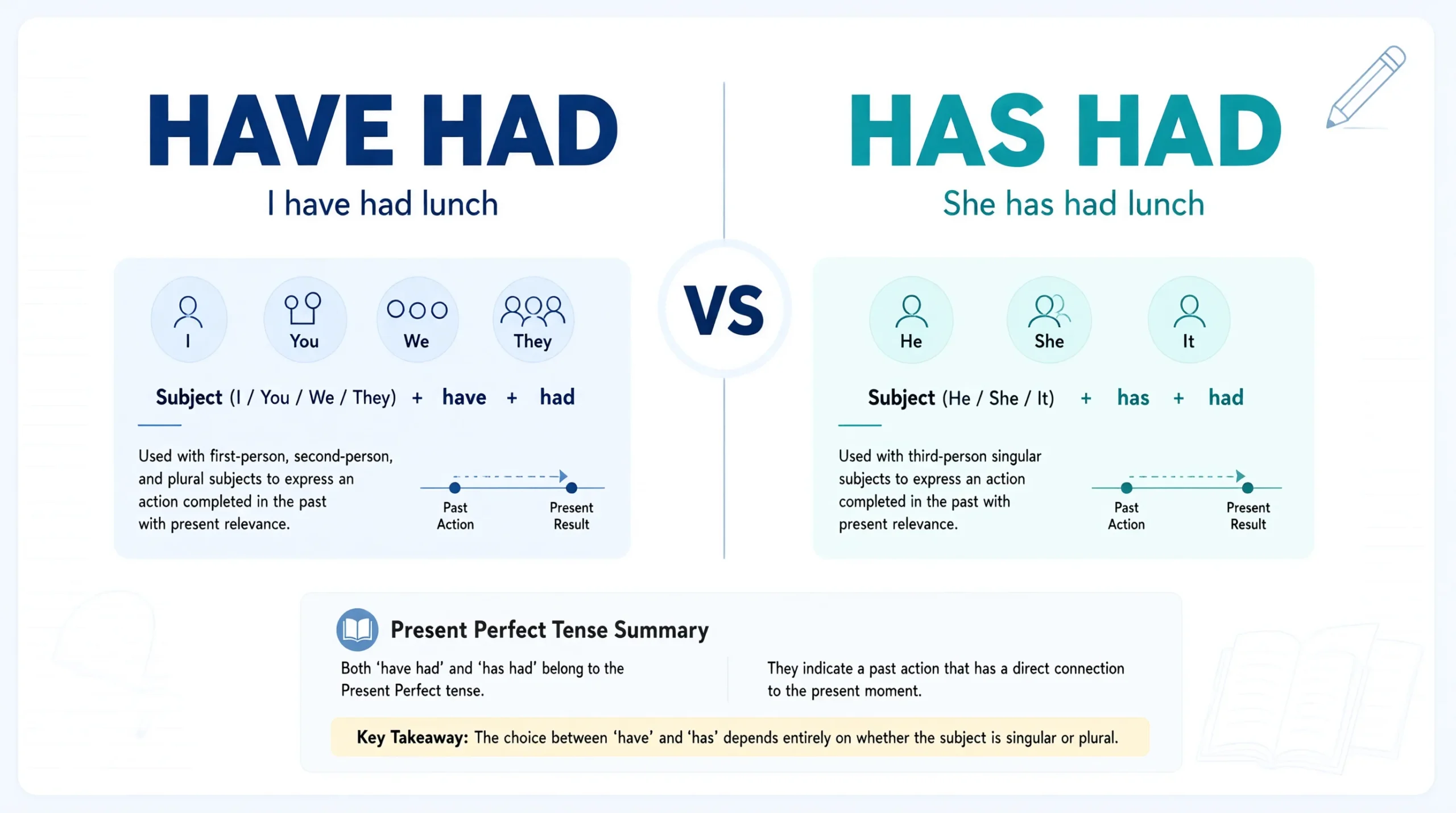
Understanding the difference between have had vs. has had can make English grammar much easier. Both expressions use the present perfect tense, but they are used with different subjects. The main difference is simple: “have had” is used with I, you, we, and they, while “has had” is used with he, she, it, and singular nouns. For example, you can say, “I have had breakfast” and “She has had breakfast.” Both sentences describe an experience or action connected to the present, but the helping verb changes according to the subject.
Although these expressions may look confusing because they contain the word “had” twice in different grammatical roles, their structure follows a clear rule. The first word, “have” or “has,” is the helping verb, while the second “had” is the past participle of “have.”
Once you understand this pattern, you can use both expressions confidently in everyday conversations, school assignments, emails, and professional writing. This guide explains their meanings, grammatical rules, differences, common mistakes, and practical examples to help you choose the correct expression every time.
Quick Answer: Have Had vs. Has Had
Have had is used with I, you, we, they, and plural subjects. Has had is used with he, she, it, and singular third-person subjects. Both expressions form the present perfect tense and describe past experiences, situations, or actions connected to the present. For example, “They have had lunch” and “He has had lunch.”
Why Do People Confuse Have Had and Has Had?
People often confuse these expressions because both contain the word “had.” However, the first verb changes depending on the subject, while the second remains the same.
Consider these examples:
- I have had a busy day.
- She has had a busy day.
- They have had enough time.
- He has had enough time.
The difference is not about whether an event happened in the past. Instead, it is about subject-verb agreement in the present perfect tense.
Remember that “have” and “has” are present-tense forms of the verb “have,” whereas “had” is its past participle in these sentences.
What Does Have Had Mean?
Have had is the present perfect form used with I, you, we, they, and plural subjects. It commonly describes experiences, completed actions, or situations that began in the past and remain relevant to the present.
Examples of Have Had
- I have had three cups of coffee today.
- You have had enough opportunities to practice.
- We have had several meetings this week.
- They have had a wonderful experience.
- My friends have had similar problems.
In each sentence, “have” is the helping verb and “had” is the main verb’s past participle.
When Is Have Had Used?
Use “have had” when the subject is I, you, we, they, or a plural noun.
For example:
- I have had this phone for two years.
- You have had plenty of time.
- We have had good results so far.
- The students have had their exams.
These sentences connect an earlier experience or situation to the present.
What Does Has Had Mean?
Has had is the present perfect form used with he, she, it, and singular third-person nouns. It describes experiences, actions, or situations that have a connection to the present.
Examples of Has Had
- He has had breakfast already.
- She has had a difficult week.
- It has had a positive effect on the results.
- My brother has had this bicycle since childhood.
- The company has had several successful years.
In these sentences, “has” is the helping verb, and “had” is the past participle.
When Is Has Had Used?
Use “has had” when the subject is a singular third-person noun or pronoun.
For example:
- Sarah has had enough rest.
- The teacher has had a busy morning.
- My dog has had its food.
- The manager has had several meetings today.
The subject determines whether you choose “has” or “have.” The meaning of the sentence does not change this basic grammatical rule.
Have Had vs. Has Had: Comparison Table
| Feature | Have Had | Has Had |
| Main use | Present perfect tense | Present perfect tense |
| Used with | I, you, we, they | He, she, it |
| Nouns | Plural subjects | Singular third-person subjects |
| Example | We have had lunch. | She has had lunch. |
| Negative form | Have not had | Has not had |
| Short form | Haven’t had | Hasn’t had |
| Question form | Have they had lunch? | Has she had lunch? |
Both expressions can describe experiences, recent actions, and situations continuing into the present. The main grammatical difference is the subject.
When Should You Use Have Had or Has Had?
Choosing the correct expression becomes easier when you identify the subject before writing the sentence.
Use Have Had With I
The pronoun “I” always takes “have had” in the present perfect tense.
- I have had enough practice.
- I have had a headache since morning.
- I have had two interviews this month.
Incorrect: I has had enough practice.
Use Have Had With You
“You” takes “have had,” whether you are speaking to one person or several people.
- You have had a great opportunity.
- You have had enough time to prepare.
Incorrect: You has had enough time.
Use Have Had With We and They
“We” and “they” also take “have had.”
- We have had many discussions.
- They have had a successful year.
Use Has Had With He, She, and It
Use “has had” with these third-person singular pronouns.
- He has had a busy day.
- She has had a new idea.
- It has had a noticeable effect.
Incorrect: He have had a busy day.
Use Has Had With Singular Nouns
A singular person’s name, animal, object, or organization generally takes “has had.”
- Ali has had lunch.
- My sister has had a cold.
- The school has had several improvements.
- The cat has had its medicine.
Use Have Had With Plural Nouns
Plural subjects take “have had.”
- The children have had their lunch.
- My parents have had a long journey.
- The employees have had additional training.
15 Examples of Have Had vs. Has Had
The following examples show how these expressions work in everyday English.
| Have Had Example | Has Had Example |
| I have had breakfast. | He has had breakfast. |
| You have had enough rest. | She has had enough rest. |
| We have had a good day. | My brother has had a good day. |
| They have had many chances. | Sarah has had many chances. |
| I have had this bag for years. | He has had this bag for years. |
| We have had several problems. | The company has had several problems. |
| You have had a busy week. | She has had a busy week. |
| They have had their lunch. | The child has had lunch. |
| My friends have had great experiences. | My friend has had great experiences. |
| The students have had their tests. | The student has had their test. |
| We have had enough practice. | Ali has had enough practice. |
| They have had a meeting today. | The manager has had a meeting today. |
| I have had a headache since morning. | She has had a headache since morning. |
| You have had excellent results. | He has had excellent results. |
| Our neighbors have had visitors. | Our neighbor has had visitors. |
Notice that the subject changes, but the basic structure remains the same.
Examples in Negative Sentences
To make these expressions negative, add “not” after the helping verb.
Have not had:
- I have not had breakfast yet.
- They have not had enough time.
- We have not had any complaints.
Has not had:
- She has not had breakfast yet.
- He has not had enough time.
- The business has not had any complaints.
The common contractions are “haven’t had” and “hasn’t had.”
Examples in Questions
Place “have” or “has” before the subject to form a question.
Questions with have had:
- Have you had lunch?
- Have they had enough practice?
- Have we had this discussion before?
Questions with has had:
- Has she had lunch?
- Has he had enough practice?
- Has the teacher had a chance to review the work?
Common Mistakes to Avoid
Even experienced English learners sometimes make mistakes with these expressions. Here are the most common ones.
Mistake 1: Using Has Had With I
Incorrect: I has had a busy day.
Correct: I have had a busy day.
The pronoun “I” takes “have,” not “has.”
Mistake 2: Using Have Had With He or She
Incorrect: She have had enough sleep.
Correct: She has had enough sleep.
Use “has” with singular third-person subjects.
Mistake 3: Replacing Had With Have or Has
Incorrect: He has have a difficult day.
Correct: He has had a difficult day.
After “has” or “have” in the present perfect tense, use the past participle “had.”
Mistake 4: Using the Wrong Form in Questions
Incorrect: Has she had breakfast?
This sentence is actually correct.
Incorrect: Has she have breakfast?
Correct: Has she had breakfast?
After “has” in this present perfect question, use “had.”
Mistake 5: Confusing Present Perfect With Simple Past
Present perfect: She has had lunch.
Simple past: She had lunch.
Both can be correct, but they emphasize different things. The present perfect connects the event to the present, while the simple past presents it as a past event. Use the simple past with a finished time expression such as “yesterday.”
Memory Trick: How to Remember the Difference
Use this simple rule:
I, You, We, They → Have Had
He, She, It → Has Had
You can also remember that plural nouns usually take “have had,” while singular third-person nouns take “has had.”
Try these quick examples:
- I ___ had dinner. (have)
- She ___ had dinner. (has)
- They ___ had enough time. (have)
- Ali ___ had enough time. (has)
When you are unsure, identify the subject first. Then choose “have” or “has.” Keep the second word “had” unchanged.
Have Had vs. Has Had in American and British English
There is no difference between American and British English in the basic grammatical rules for “have had” and “has had.” Both varieties use these forms according to the subject.
Examples in both varieties:
- I have had a busy week.
- She has had a busy week.
- They have had enough time.
Some differences may appear in pronunciation, accent, and everyday phrasing, but the subject-verb agreement rule remains the same.
British English sometimes uses “have got” to express possession, as in “I have got a new phone.” American English commonly uses “I have a new phone.” These are related expressions, but they do not change the rules for “have had” and “has had.”
Similar Words and Expressions
Understanding related verb forms can help you avoid confusion.
Have vs. Has
“Have” and “has” are present-tense forms of the verb “have.”
- I have a book.
- She has a book.
Had vs. Have Had
“Had” can describe a past event, while “have had” is used in the present perfect tense.
- I had lunch yesterday.
- I have had lunch already.
The first sentence places the event in a finished past time. The second connects the event to the present.
Had vs. Has Had
Use “had” with all subjects in the simple past.
- I had a car.
- She had a car.
- They had a car.
Use “has had” with a singular third-person subject in the present perfect.
- She has had a car for three years.
Have Had vs. Had Had
“Have had” is present perfect, whereas “had had” is past perfect.
- I have had enough experience. (Present perfect)
- I had had enough experience before I applied. (Past perfect)
In the second example, “had had” describes a situation that occurred before another past event.
FAQs:
1. Is It Have Had or Has Had?
Both are correct. Use “have had” with I, you, we, they, and plural subjects. Use “has had” with he, she, it, and singular third-person subjects.
2. Is Has Had Grammatically Correct?
Yes. “Has had” is grammatically correct when the subject is singular and third person. For example, “She has had enough time to finish the project.”
3. Can I Say “I Has Had”?
No. The correct form is “I have had.” The pronoun “I” always takes “have” in the present perfect tense.
4. What Is the Difference Between Have Had and Had?
“Have had” is the present perfect form, often connecting a past experience or situation to the present. “Had” is the simple past form and usually describes a situation or event at a past time.
Example: “I have had breakfast already” and “I had breakfast yesterday.”
5. Is “She Has Had” Correct?
Yes. “She has had” is correct because “she” is a singular third-person pronoun. For example, “She has had this phone for two years.”
6. How Do You Make Have Had and Has Had Negative?
Add “not” after the helping verb:
- I have not had lunch.
- She has not had lunch.
You can also use the contractions “haven’t had” and “hasn’t had.”
7. How Do You Form Questions With Have Had and Has Had?
Put the helping verb before the subject.
- Have you had breakfast?
- Has he had breakfast?
Use “have” or “has” according to the subject.
8. Can Have Had and Has Had Describe Something That Started in the Past and Continues Now?
Yes. They can describe situations that began in the past and continue into the present.
- I have had this job for five years.
- She has had this job for five years.
The word “for” often indicates a duration, while “since” identifies the starting point.
Remember This
- Have had: I, you, we, they, and plural nouns.
- Has had: He, she, it, and singular third-person nouns.
- Both forms use the present perfect tense.
- “Have” and “has” are helping verbs; “had” is the past participle.
- For negative sentences, use “have not had” or “has not had.”
- For questions, place “have” or “has” before the subject.
Conclusion
The difference between “have had” and “has had” is straightforward once you understand subject-verb agreement. Both expressions use the present perfect tense, but the correct form depends on the subject. Use “have had” with I, you, we, they, and plural nouns. Use “has had” with he, she, it, and singular third-person nouns. For example, “We have had enough time” is correct, while “He has had enough time” is also correct.
To improve your grammar, practice making affirmative sentences, negative sentences, and questions with both forms. Pay attention to the subject before choosing the helping verb, and remember that “had” stays the same in both expressions. With regular practice, you will be able to use “have had” and “has had” naturally in conversations, academic writing, and professional communication.

I create fun, creative pickup lines and flirty messages that help people feel confident, spark conversations, and make their chats more playful, memorable, and enjoyable.