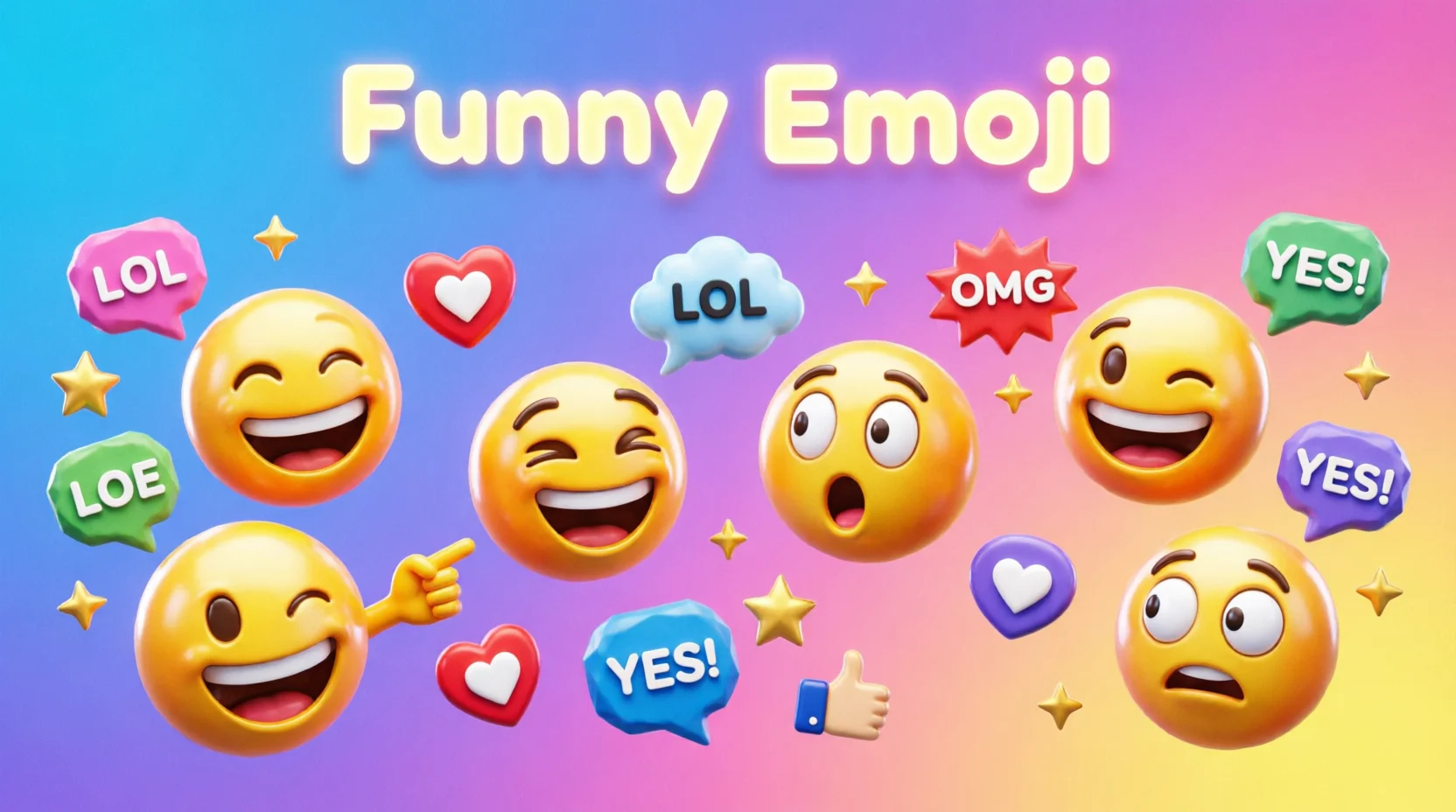
Emojis make online conversations more expressive, and funny emojis are some of the easiest ways to show laughter, amusement, sarcasm, or a playful mood. Popular choices include 😂, 🤣, 😆, 😹, and 😜. While these emojis can all suggest something is funny, each one can communicate a slightly different feeling depending on the conversation.
If you are replying to a hilarious text, reacting to a meme, adding humor to a social media post, or making a casual message feel friendlier, the right funny emoji can make your meaning clearer. This guide explains the most popular funny emojis, what they mean, how they differ, and how to use them naturally.
Quick Answer: What Is a Funny Emoji?
A funny emoji is an emoji used to express laughter, amusement, joking, teasing, silliness, or a playful reaction. Common funny emojis include 😂 Face with Tears of Joy, 🤣 Rolling on the Floor Laughing, 😆 Grinning Squinting Face, 😹 Cat With Tears of Joy, and 😜 Winking Face With Tongue.
The best emoji depends on how strongly you are laughing and the tone you want to create. 😂 is a general choice for something genuinely funny, while 🤣 usually suggests stronger laughter.
What Does the Funny Emoji 😂 Mean?
The 😂 emoji is officially known as Face with Tears of Joy. It generally represents laughing so hard that tears come to your eyes.
People commonly use it when:
- A joke is genuinely funny
- A friend sends a hilarious message
- They react to a funny video or meme
- Something unexpected makes them laugh
- They want to make a casual reply more playful
Examples
That was the funniest thing I have seen today 😂
You really said that in front of everyone 😂
I cannot stop laughing at this video 😂
The emoji does not always mean that the person is literally crying from laughter. In everyday digital communication, it often simply means “That is really funny.”
What Does 🤣 Mean?
The 🤣 emoji is known as Rolling on the Floor Laughing. It generally communicates more intense laughter than 😂.
Use 🤣 when something is extremely funny or when you want to exaggerate your reaction for a playful effect.
Example:
Bro, your reaction was everything 🤣
I watched that clip three times 🤣
You actually believed him? 🤣
A useful distinction is that 😂 can be a normal funny reaction, while 🤣 often feels more exaggerated or energetic.
Popular Funny Emojis and Their Meanings
Different emojis can communicate different types of humor. Here is a simple comparison:
| Emoji | Common Meaning | Typical Feeling |
|---|---|---|
| 😂 | Laughing with tears | Genuine amusement |
| 🤣 | Extreme laughter | Very funny |
| 😆 | Big grin and laughter | Excited amusement |
| 😹 | Cat laughing with tears | Cute or silly humor |
| 😜 | Playful or teasing | Mischievous humor |
| 😝 | Silly expression | Goofy or playful |
| 😏 | Smirking | Teasing or suggestive humor |
| 🙃 | Ironic or awkward humor | Dry humor |
| 💀 | “I’m dead” from laughter | Internet slang humor |
| 😭 | Overwhelmed or laughing hard | Dramatic reaction |
The same emoji can have different meanings depending on the person, conversation, and platform.
When Should You Use a Funny Emoji?
Funny emojis work best when the surrounding message already has a playful or casual tone.
In Text Messages
You can use them to show that you are joking.
I totally forgot we had homework 😂
In Group Chats
Funny emojis can make reactions more expressive.
Everyone saw that happen and nobody said anything 🤣
On Social Media
They can add personality to captions and comments.
When you say you are going to sleep early but open one more video 😂
With Friends
Friends often use funny emojis to tease each other.
You really thought you could beat me at this game 🤣
In Memes
A laughing emoji can reinforce your reaction to a meme.
This meme is way too accurate 😂
Funny Emoji Combinations
Using two or more emojis can create a stronger reaction.
Here are some popular combinations:
- 😂🤣 — laughing extremely hard
- 😂😭 — laughing so hard it feels emotional
- 🤣💀 — extremely funny
- 😭😂 — dramatic laughter
- 😆😂 — happy amusement
- 😜😂 — playful joke
- 💀🤣 — internet-style exaggerated laughter
- 😹😂 — cute and funny reaction
For casual conversations, combinations can be more expressive than using one emoji alone.
Funny Emoji vs Laughing Emoji
The terms funny emoji and laughing emoji are often used interchangeably, but they can describe slightly different things.
A laughing emoji specifically communicates laughter or amusement. A funny emoji can have a broader purpose, including teasing, sarcasm, silliness, irony, or playful reactions.
For example:
😂 = laughing at something
😜 = joking or teasing
🙃 = possibly reacting ironically
💀 = saying something is so funny that you are “dead”
So, not every funny emoji has to show a traditional laughing face.
How Do You Choose the Right Funny Emoji?
Choosing an emoji becomes easier when you consider the strength and type of your reaction.
For Normal Laughter
Use 😂.
That joke was actually good 😂
For Very Strong Laughter
Use 🤣.
I cannot believe you did that 🤣
For Playful Teasing
Use 😜.
Nice try 😜
For Goofy Humor
Use 😝.
I have absolutely no idea what I am doing 😝
For Internet-Style Humor
Use 💀.
That ending took me out 💀
For Sarcastic or Ironic Humor
Use 🙃.
Another meeting that could have been an email 🙃
Funny Emoji Examples for Different Situations
Funny Replies to Friends
- You are impossible 😂
- Stop, I am actually laughing 🤣
- Why are you like this? 😂
- I was not ready for that 😭😂
- You got me there 🤣
- That was too good 😂
- I cannot with you 💀
- Okay, that was funny 😆
Funny Social Media Comments
- This is too accurate 😂
- I was not expecting that 🤣
- The ending got me 💀
- Why is this so funny? 😂
- I am crying 😭
- This made my day 😆
- Absolutely hilarious 🤣
Playful Responses
- Sure, keep telling yourself that 😜
- Nice attempt 😂
- You wish 😏
- Okay, comedian 🤣
- I see what you did there 😂
What Does 😂 Mean in Texting?
In texting, 😂 usually means that the sender finds something funny. It can also soften a statement that might otherwise sound too serious, blunt, or awkward.
For example:
You are so annoying 😂
Without the emoji, the message could sound genuinely angry. With 😂, it is more likely to feel playful.
However, context matters. If someone uses 😂 after a serious statement, the meaning may be more complicated. It could indicate nervousness, sarcasm, discomfort, or an attempt to make an awkward situation lighter.
Can Funny Emojis Be Sarcastic?
Yes. Funny emojis can be used sarcastically, but the meaning depends heavily on context.
Consider:
Great, another Monday 😂
The person probably is not laughing because Monday is literally hilarious. Instead, the emoji helps communicate an ironic reaction.
Similarly:
Love spending two hours fixing one tiny problem 😂
Here, the emoji can signal frustration mixed with humor.
Because sarcasm is difficult to communicate through text, emojis can help provide additional emotional context.
Funny Emoji Meanings Can Change With Context
One of the biggest mistakes people make is assuming that every emoji has one fixed meaning.
For example, 😂 can mean:
- That is hilarious
- I am laughing
- I cannot believe that happened
- That is awkwardly funny
- I am joking
- I am trying to make this message less serious
The words surrounding the emoji usually provide the missing context.
Compare:
You are hilarious 😂
with:
I just lost my phone again 😂
Both use the same emoji, but the emotional situations are different.
Common Mistakes When Using Funny Emojis
Using Too Many Emojis
A message like:
That was so funny 😂🤣😂🤣😂🤣😂🤣
can feel excessive. One or two emojis are usually enough for a normal conversation.
Using a Laughing Emoji in a Serious Situation
If someone is discussing grief, illness, a personal problem, or another sensitive subject, a laughing emoji can easily appear disrespectful.
Always consider the emotional context before reacting.
Assuming Everyone Uses Emojis the Same Way
Age, culture, personality, and online communities can influence emoji meanings. A symbol that feels normal to one person may feel sarcastic or strange to another.
Using Sarcastic Emojis Without Clear Context
Sarcasm can be difficult to understand in text. If the meaning could be misunderstood, add words that clarify your intention.
Practical Tips for Using Funny Emojis Naturally
Match the emoji to the emotion. Use 😂 for ordinary laughter and 🤣 when the reaction is stronger.
Consider your relationship. Casual emojis work naturally with friends but may not be appropriate in every professional conversation.
Look at the message first. The same emoji can communicate different emotions depending on the words around it.
Do not rely only on emojis. If your meaning is important, use words as well.
Use combinations sparingly. Two emojis can emphasize a reaction without making the message visually overwhelming.
Remember the audience. A professional email, school assignment, or formal announcement usually does not need casual laughing emojis.
FAQs:
1. What is the most common funny emoji?
😂 is one of the most recognizable emojis for expressing laughter and amusement. It is commonly used in casual texting, social media comments, memes, and group chats.
2. What emoji means “that is so funny”?
😂, 🤣, and 😆 can all communicate that something is funny. 😂 is a general choice, while 🤣 usually suggests stronger laughter.
3. What does 😂 mean from a girl or guy?
The basic meaning is usually laughter or amusement, regardless of who sends it. The exact tone depends on the conversation and relationship between the people.
4. Is 🤣 stronger than 😂?
Generally, yes. 🤣 often communicates more intense or exaggerated laughter, while 😂 is more broadly used for something amusing.
5. What emoji means laughing so hard?
😂 and 🤣 are the most direct choices. 🤣 is especially suitable when you want to communicate extremely strong laughter.
6. Can 😂 be sarcastic?
Yes. 😂 can sometimes be used to soften sarcasm, irony, awkwardness, or frustration. The surrounding words determine the intended meaning.
7. What does 💀 mean in a funny text?
💀 is often internet slang for something being extremely funny, based on the expression “I am dead” from laughter. It usually does not literally refer to death.
8. Which funny emoji should I use with friends?
😂 is a safe general choice. You can use 🤣 for stronger laughter, 😜 for teasing, 😝 for silliness, and 💀 for informal internet-style humor.
Conclusion
Funny emojis make digital conversations more expressive by showing laughter, amusement, teasing, irony, and playful reactions. Popular choices such as 😂, 🤣, 😆, 😜, and 💀 can communicate slightly different moods, so the best choice depends on the situation and the strength of your reaction.
The key is to use funny emojis naturally and consider the context before sending them. A simple 😂 can make a casual message warmer, while 🤣 can emphasize strong laughter. When you understand these differences, you can make texts, comments, captions, and group chats more expressive without overusing emojis.

I’m Connor James, an administrator at FlirtyLinz, passionate about pickup lines, playful conversations, dating, and helping readers find fun, confident, and creative ways to start conversations.