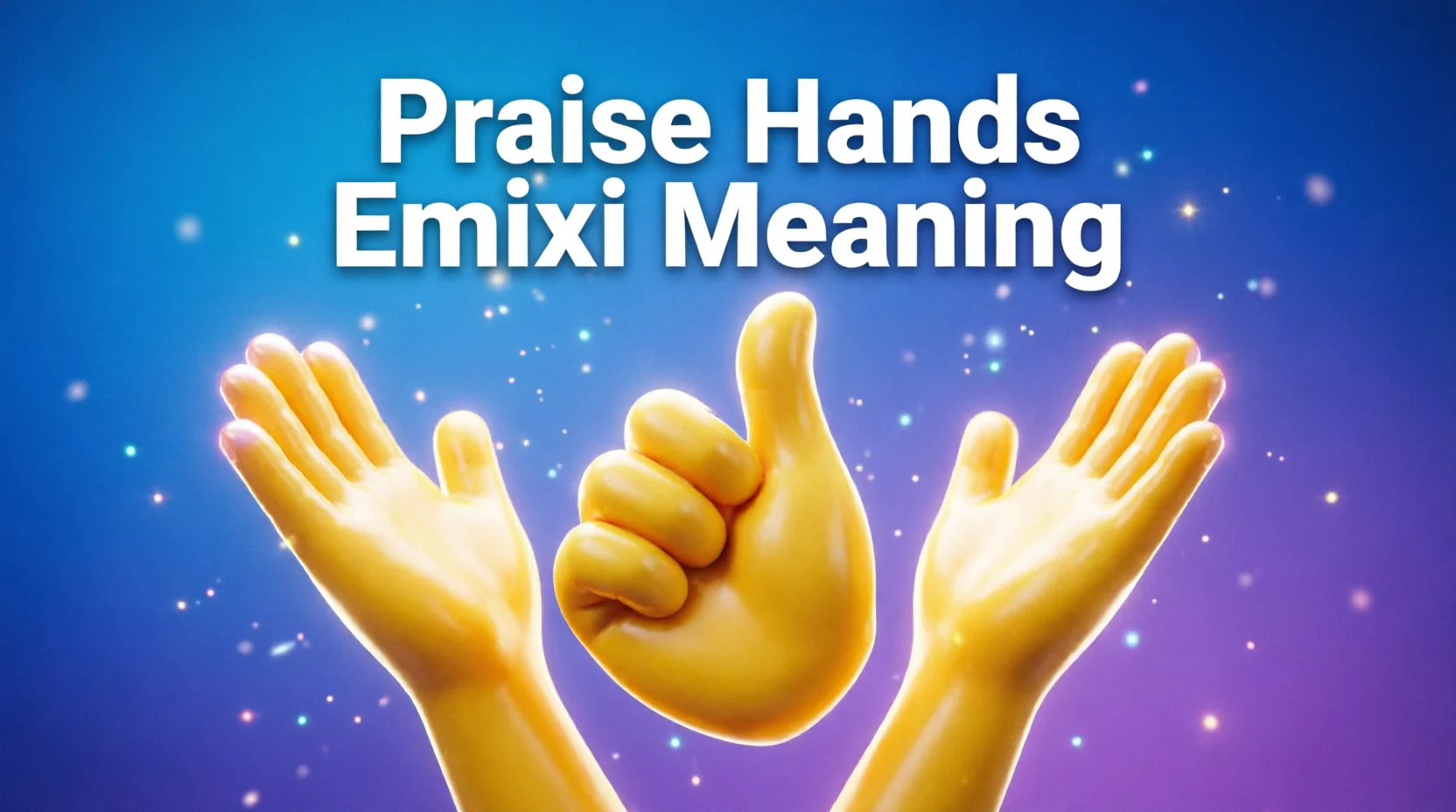
The praise hands emoji 🙌 is commonly used to express celebration, excitement, gratitude, support, and happiness. It shows two raised hands and is often called the raising hands emoji or hands-up emoji. People use 🙌 in text messages, Instagram captions, WhatsApp chats, and social media posts to celebrate good news, appreciate someone’s efforts, or show enthusiasm. For example, “I finally passed my exam 🙌” expresses happiness and excitement. Although some people use it to show praise or gratitude, its exact meaning depends on the conversation, culture, and context.
Quick Answer: What Does the Praise Hands Emoji 🙌 Mean?
The praise hands emoji 🙌 usually means celebration, excitement, appreciation, success, or enthusiastic agreement. It can communicate feelings such as “Hooray!”, “We did it!”, “Thank goodness!”, or “That’s amazing!”
Here are its most common meanings:
| Meaning | Example |
| Celebration | We finally made it 🙌 |
| Excitement | The weekend is here 🙌 |
| Gratitude | Thank you so much 🙌 |
| Success | I passed my driving test 🙌 |
| Support | You’ve got this 🙌 |
| Praise | Amazing work 🙌 |
| Relief | The problem is finally solved 🙌 |
| Agreement | Exactly what I was thinking 🙌 |
The emoji is generally positive, making it a popular choice for friendly conversations and uplifting social media content.
What Is the Praise Hands Emoji?
🙌
Raising Hands Emoji
Common name: Praise hands
Unicode name: Raising Hands
Unicode code point: U+1F64C
The 🙌 emoji depicts two hands raised in the air, with the palms facing forward. Depending on the situation, the gesture can suggest cheering, celebrating, praising, or expressing excitement.
It is often used when something good happens. For instance, someone might send 🙌 after receiving a job offer, finishing a difficult project, or hearing exciting news from a friend.
The emoji is also popular in motivational messages because raised hands can symbolize achievement, confidence, and a positive attitude.
Why Do People Use the 🙌 Emoji?
The praise hands emoji is flexible because the gesture can communicate several related emotions.
1. To Celebrate Good News
One of the most common uses of 🙌 is celebrating an achievement or exciting event.
Examples:
- I got the job! 🙌
- We won the final match 🙌
- My vacation starts tomorrow 🙌
- Finally finished my exams 🙌
In these examples, the emoji adds enthusiasm to the message.
2. To Show Gratitude
People sometimes use 🙌 to express appreciation or relief when someone helps them.
For example:
“Thank you for helping me finish the project 🙌”
Here, the raised hands add a warm, appreciative tone. However, the emoji does not always mean a literal thank-you; the words and situation determine the exact message.
3. To Praise Someone
The emoji can also communicate admiration for another person’s effort or accomplishment.
Examples:
- You did an amazing job 🙌
- So proud of you 🙌
- That performance was incredible 🙌
It works especially well when you want to celebrate someone without writing a long response.
4. To Express Relief
Sometimes, 🙌 communicates the feeling of being free from stress or worry.
For example:
“The deadline has been extended! 🙌”
The emoji suggests relief and happiness about the positive change.
5. To Show Enthusiasm and Agreement
When someone shares an idea you love, 🙌 can show that you strongly agree.
Example:
“Let’s take a weekend trip!”
“I’m absolutely in 🙌”
In this situation, the emoji adds energy and makes the response feel more enthusiastic.
Praise Hands Emoji vs. Other Hand Emojis
Not all hand emojis communicate the same thing. The shape and position of the hands can change the meaning significantly.
| Emoji | Common Name | Typical Meaning |
| 🙌 | Raising hands | Celebration, excitement, praise |
| 🙏 | Folded hands | Prayer, gratitude, or asking for something |
| 👏 | Clapping hands | Applause, approval, congratulations |
| ✋ | Raised hand | Stop, greeting, or requesting attention |
| 👐 | Open hands | Openness, affection, or offering a hug |
| 🤲 | Palms up together | Asking, receiving, or offering |
| 💪 | Flexed biceps | Strength, effort, and determination |
| 🤝 | Handshake | Agreement, cooperation, or partnership |
What Is the Difference Between 🙌 and 🙏?
The difference is mainly the gesture and the usual meaning.
- 🙌 Praise hands: Often represents celebration, excitement, or praise.
- 🙏 Folded hands: Often represents prayer, gratitude, a request, or appreciation.
For example, “We won the championship 🙌” celebrates success, while “Please keep my family in your prayers 🙏” expresses a request.
However, 🙏 can also mean thank you, and 🙌 can express gratitude. Their meanings sometimes overlap.
What Is the Difference Between 🙌 and 👏?
The clapping hands emoji 👏 usually represents applause, recognition, or approval. The raising hands emoji 🙌 more often expresses excitement, celebration, or a feeling of triumph.
For example:
- “Your presentation was excellent 👏” gives applause.
- “We finally completed the project 🙌” celebrates an achievement.
Both are positive, but they emphasize slightly different feelings.
How to Use the Praise Hands Emoji in Text Messages
The 🙌 emoji can make everyday messages feel more expressive. Here are examples for common situations.
In Friendly Conversations
- “That’s such good news 🙌”
- “Can’t wait to see you 🙌”
- “We finally made plans 🙌”
- “You deserve all the happiness 🙌”
In Family Chats
- “Everyone is coming for dinner tonight 🙌”
- “Grandma is feeling better 🙌”
- “The whole family will be together this weekend 🙌”
In Work Conversations
- “The presentation was approved 🙌”
- “Great work, everyone 🙌”
- “We reached our monthly target 🙌”
- “The client loved the final design 🙌”
In professional conversations, use the emoji when it fits your workplace culture. It is generally more suitable for friendly team chats than formal business documents.
In Study and School Messages
- “I passed the exam 🙌”
- “Assignment submitted 🙌”
- “Finally finished the semester 🙌”
- “We completed the group project 🙌”
These messages show excitement about academic progress.
Praise Hands Emoji Combinations and Their Meanings
Combining 🙌 with another emoji can add extra meaning to a message.
🙌🎉
Celebration and excitement
For parties, milestones, wins, and exciting announcements.
Example: “We did it! 🙌🎉”
Copy
🙌❤️
Love and appreciation
For expressing heartfelt happiness or appreciation.
Example: “So grateful for you 🙌❤️”
Copy
🙌✨
Positive energy and achievement
For good news, personal milestones, or uplifting moments.
Example: “A fresh start and new opportunities 🙌✨”
Copy
🙌💯
Strong approval
For complete agreement or enthusiastic support.
Example: “That advice is absolutely right 🙌💯”
Copy
🙌🙏
Gratitude and praise
For expressing deep appreciation or thankfulness.
Example: “Thankful for all the support 🙌🙏”
Copy
🙌🥳
A big personal win
For birthdays, promotions, graduations, and celebrations.
Example: “Promotion confirmed! 🙌🥳”
Copy
These combinations are informal examples rather than fixed definitions. People may interpret them differently depending on the message.
Praise Hands Emoji for Instagram, WhatsApp, and TikTok
The 🙌 emoji is popular across social platforms because it is easy to recognize and adds emotion without requiring extra words.
Instagram Captions
Use it to celebrate personal growth, achievements, friendships, and memorable experiences.
- Grateful for how far I’ve come 🙌
- Small wins deserve big celebrations 🙌🎉
- New chapter, new opportunities 🙌✨
- Surround yourself with positive energy 🙌❤️
- One step closer to the dream 🙌💯
WhatsApp Status Ideas
For WhatsApp, short and conversational messages usually work best.
- Finally, some good news 🙌
- Feeling blessed and grateful 🙌
- Weekend plans are confirmed 🙌🎉
- Hard work paid off 🙌
- Thankful for today 🙌❤️
TikTok Captions
The emoji can add energy to short videos about accomplishments, celebrations, or positive changes.
- When everything finally works out 🙌
- That feeling when you reach your goal 🙌🎯
- A little progress is still progress 🙌✨
- The moment you’ve been waiting for 🙌🎉
- Celebrating the small victories 🙌💯
For the clearest caption, combine the emoji with words that explain what you are celebrating.
Does the Praise Hands Emoji Have a Religious Meaning?
The 🙌 emoji can have a spiritual or religious meaning in certain contexts, but it is not exclusively religious.
Raising hands is a gesture used in some worship settings to express praise, devotion, gratitude, or prayer. Consequently, people may use 🙌 in messages about faith, religious gatherings, or spiritual experiences.
For example:
- “Feeling thankful for every blessing 🙌”
- “A beautiful evening of worship 🙌”
- “Grateful for another day 🙌”
However, many people use the same emoji in entirely nonreligious situations, such as celebrating a sports victory, finishing school, or receiving good news.
It is therefore best not to assume that someone is expressing a religious belief simply because they use 🙌.
Common Mistakes When Interpreting 🙌
Although the emoji is usually positive, a few misunderstandings are possible.
1. Assuming It Always Means Prayer
The raised-hands gesture is different from the folded-hands gesture represented by 🙏. Although 🙌 may appear in spiritual messages, it commonly expresses celebration and excitement.
2. Confusing It With Applause
The 👏 emoji more directly represents clapping or applause. The 🙌 emoji usually suggests raised hands, enthusiasm, or celebration.
3. Assuming It Always Means Gratitude
Someone may send 🙌 to celebrate a victory rather than to say thank you. Read the surrounding words before deciding what they mean.
4. Using It in Every Conversation
The emoji suits cheerful and positive situations, but it may seem insensitive when someone shares disappointing or serious news. Choose a response that matches the other person’s emotions.
5. Treating Its Meaning as Universal
Emoji interpretations can vary by individual, culture, and situation. When the meaning is unclear, consider the conversation rather than relying on the symbol alone.
Practical Tips for Using the Praise Hands Emoji
Follow these tips to make your messages clearer and more natural.
- Match the emotion: Use 🙌 for excitement, celebration, praise, or enthusiastic support.
- Add context: Write “We passed the exam 🙌” instead of sending only the emoji when clarity matters.
- Choose combinations carefully: Pair 🙌 with 🎉 for celebrations or ❤️ for appreciation.
- Consider the audience: Casual messages can include more emojis than formal communication.
- Avoid overusing it: One well-placed emoji often communicates more effectively than a long string.
- Check the conversation: A person’s words and tone help you understand whether they mean celebration, gratitude, or agreement.
- Remember that appearance varies: The design may look slightly different across phones, apps, and operating systems, even though the underlying emoji is the same.
FAQs:
1. What does 🙌 mean in texting?
In texting, 🙌 usually means celebration, excitement, praise, or enthusiastic agreement. It can also express gratitude or relief, depending on the conversation.
2. Is 🙌 the same as 🙏?
No. 🙌 depicts raised hands and commonly expresses celebration or praise. 🙏 depicts folded hands and is often used for prayer, gratitude, or requests. Their meanings can overlap.
3. Does 🙌 mean thank you?
It can. People sometimes use 🙌 to show appreciation or gratitude, especially after receiving help or hearing good news. However, it can also simply mean “Hooray!” or “We did it!”
4. What is the official name of 🙌?
Its Unicode name is “Raising Hands.” The phrase “praise hands emoji” is a popular informal name because the gesture is associated with praise and celebration.
5. Is 🙌 a positive emoji?
Yes, it is generally positive. It usually communicates happiness, enthusiasm, support, success, or appreciation, although its exact meaning depends on the context.
6. What does 🙌 mean from a friend?
A friend may use it to celebrate your achievement, agree enthusiastically, show support, or share excitement. The surrounding conversation will usually clarify the intended meaning.
7. Can I use 🙌 in professional messages?
Yes, particularly in informal team chats, project updates, and messages celebrating achievements. For formal documents or serious situations, words alone may be more appropriate.
8. What are the best emojis to combine with 🙌?
Popular combinations include 🙌🎉 for celebration, 🙌❤️ for appreciation, 🙌✨ for positive energy, and 🙌💯 for strong approval. Choose a combination that matches your intended message.
Conclusion
The praise hands emoji 🙌 is a versatile symbol that usually expresses celebration, excitement, appreciation, success, and support. It is useful in everyday texting, Instagram captions, WhatsApp statuses, TikTok posts, and workplace chats. Although it can also communicate gratitude or spiritual praise, its meaning depends on the context and the words around it.
To use 🙌 effectively, choose combinations that match your feelings and audience. Pair it with 🎉 to celebrate, ❤️ to show appreciation, or 💯 to express strong approval. If you are sharing good news or encouraging a friend, this simple emoji can make your message feel warmer and more enthusiastic.

I create fun, creative pickup lines and flirty messages that help people feel confident, spark conversations, and make their chats more playful, memorable, and enjoyable.