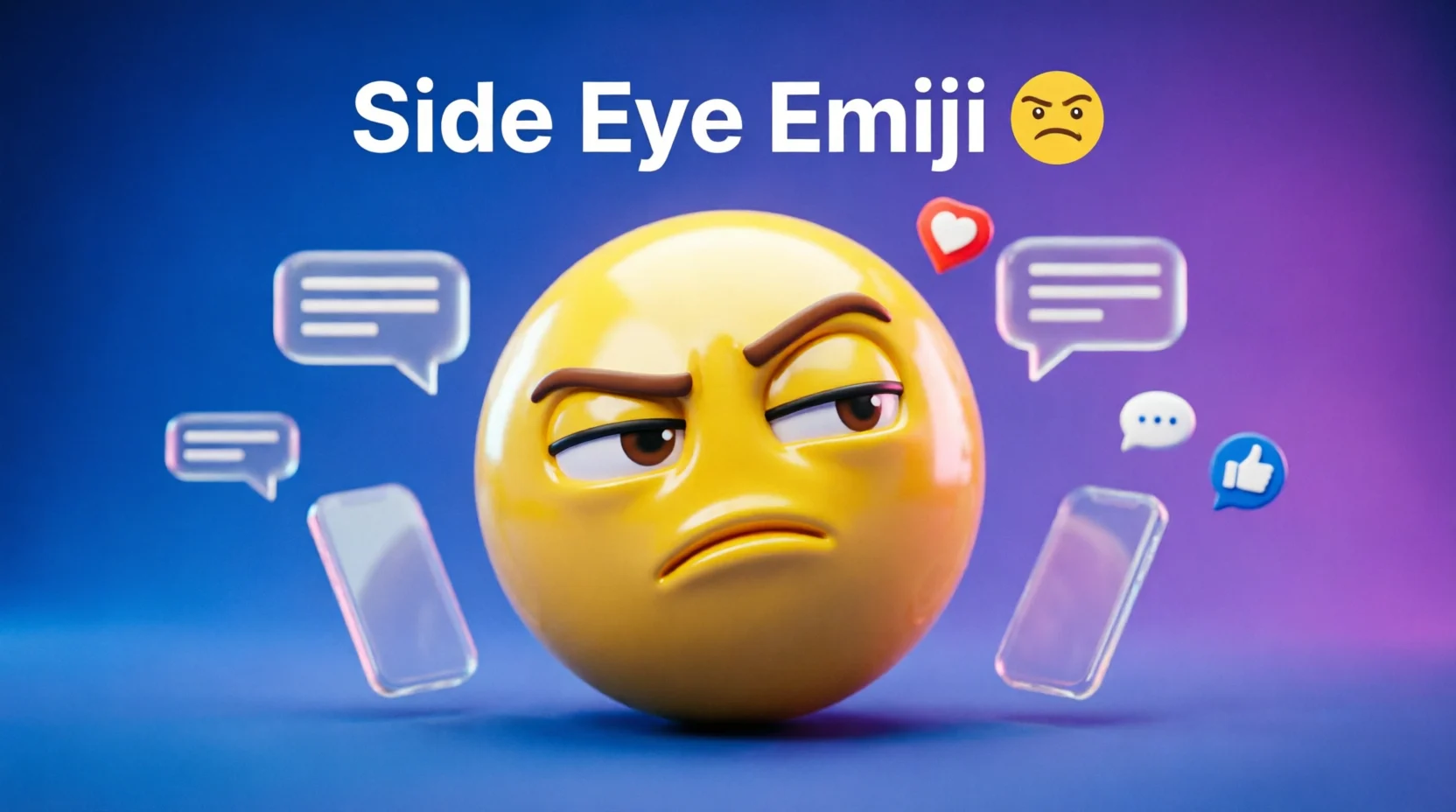
The side eye emoji 🙄 usually expresses annoyance, disbelief, sarcasm, doubt, boredom, or a reaction like “Seriously?” or “Are you kidding me?” People often use it when words alone do not fully capture their reaction. Depending on the conversation, it can be playful, sarcastic, dismissive, or genuinely irritated.
Emoji meaning depends heavily on context, relationship, and tone. A friend sending 🙄 after a silly joke may be teasing, while the same emoji in a serious conversation can sound annoyed or disrespectful. Understanding these differences can help you use the side eye emoji naturally in texts, social media posts, comments, and online conversations.
Quick Answer: What Does the Side Eye Emoji 🙄 Mean?
The side eye emoji 🙄 is commonly used to show annoyance, disbelief, skepticism, sarcasm, impatience, or “I can’t believe this” energy. It can also mean that someone finds a statement ridiculous or does not take it seriously.
For example:
Friend: “I only bought one pair of shoes this month.”
You: “You bought five yesterday. 🙄”
Here, 🙄 adds a playful, skeptical reaction rather than serious anger.
What Is the Side Eye Emoji?
The side eye emoji is usually represented by 🙄, officially associated with the idea of a face showing an eye-rolling reaction.
The emoji features a face with eyes looking upward. Because eye-rolling is commonly associated with irritation, disbelief, sarcasm, or exasperation, the emoji developed into a popular way to communicate those feelings digitally.
In face-to-face communication, people can use facial expressions, gestures, voice tone, and body language. Text messages do not provide those signals automatically. Emojis help fill that communication gap.
Therefore, 🙄 can add emotional context to a short message.
For example:
- “Okay, sure. 🙄”
- “You really believe that? 🙄”
- “Here we go again. 🙄”
- “He said he wasn’t hungry and then ate my fries. 🙄”
In each example, the emoji adds a feeling that would otherwise be difficult to detect from the words alone.
What Does 🙄 Mean in Texting?
In texting, 🙄 generally means “I’m annoyed,” “I don’t believe you,” or “Seriously?”
However, the exact meaning can change depending on the conversation.
| Message | Possible meaning of 🙄 |
|---|---|
| “He forgot my birthday again. 🙄” | Frustration |
| “You think you’re funny? 🙄” | Sarcasm |
| “She said she doesn’t like chocolate. 🙄” | Disbelief |
| “Monday is here again. 🙄” | Boredom or frustration |
| “You bought another hoodie? 🙄” | Playful teasing |
| “Sure, whatever. 🙄” | Dismissiveness |
| “Not this story again. 🙄” | Impatience |
| “You actually believed him? 🙄” | Skepticism |
The safest interpretation comes from the surrounding words and the relationship between the people communicating.
Why Do People Use the Side Eye Emoji?
People use 🙄 because it communicates a reaction quickly.
Instead of writing:
“I cannot believe you just said that, and I think what you said was ridiculous.”
Someone can simply write:
“🙄”
That single emoji can communicate a strong emotional response.
Common reasons people use it include:
1. To Show Annoyance
Someone may use 🙄 when they are irritated by something.
Example:
“Of course the internet stopped working again. 🙄”
2. To Show Disbelief
The emoji can communicate that someone does not believe what they just heard.
Example:
“You finished the entire cake by yourself? 🙄”
3. To Be Sarcastic
It can make a sarcastic statement more obvious.
Example:
“Yeah, because being late every day is totally professional. 🙄”
4. To Tease a Friend
Among close friends, 🙄 can be humorous rather than hostile.
Example:
“You’re talking about your favorite celebrity again. 🙄😂”
5. To Show Impatience
It may indicate that someone is tired of hearing the same thing.
Example:
“Are we seriously still discussing this? 🙄”
Is 🙄 a Rude Emoji?
Sometimes, yes, but not always.
The side eye emoji can sound rude because eye-rolling is often interpreted as dismissive or disrespectful in face-to-face communication.
However, friends may use it casually without intending offense.
Compare these examples:
Playful:
“You forgot your keys again. 🙄😂”
More negative:
“Whatever you say. 🙄”
The first example can sound affectionate or humorous. The second may suggest frustration or disrespect.
Consequently, you should consider the person, situation, and wording before using it.
🙄 vs. Other Similar Emojis
Several emojis can express reactions similar to side eye, but they do not communicate exactly the same feeling.
| Emoji | Common meaning | Typical tone |
|---|---|---|
| 🙄 | Annoyance, disbelief, eye-rolling | Sarcastic or irritated |
| 😒 | Unimpressed or dissatisfied | More directly negative |
| 😑 | Expressionless or tired | Emotionally flat |
| 😏 | Smirk, confidence, suggestiveness | Playful or sly |
| 😬 | Awkwardness or discomfort | Nervous |
| 🤨 | Suspicion or questioning | Skeptical |
| 😐 | Neutral reaction | Indifferent |
| 😤 | Frustration or anger | Stronger emotion |
For example, 🤨 often feels more like “Really?” while 🙄 feels more like “Oh, come on.”
Similarly, 😒 can communicate dissatisfaction without the stronger eye-rolling idea associated with 🙄.
When Should You Use the Side Eye Emoji?
The side eye emoji works well in casual digital conversations.
You can use it when:
- A friend tells an obviously questionable story.
- Someone makes an exaggerated claim.
- You are joking with someone you know well.
- You are reacting to an annoying situation.
- Someone repeats something you have already heard.
- You want to add sarcasm to a message.
- You are expressing mild disbelief.
- You are commenting on something ridiculous.
Example Texts With 🙄
- “You said that last week too. 🙄”
- “Another meeting? 🙄”
- “He really thinks he can get away with that. 🙄”
- “You ate my snacks again. 🙄”
- “You forgot your password again? 🙄”
- “Wow, what a surprise. 🙄”
- “You call that an excuse? 🙄”
- “Not you starting this again. 🙄”
When Should You Avoid 🙄?
Although the emoji is common, it is not appropriate for every situation.
Avoid using 🙄 when speaking to someone who may interpret it as disrespectful, particularly in formal or sensitive conversations.
For example, sending:
“I understand your concern. 🙄”
to a manager, teacher, customer, or professional contact could make the message appear dismissive.
Likewise, using it during an emotional disagreement may make the situation worse.
Instead, use clearer words when the conversation requires respect and precision.
For example:
“I understand your point, but I see it differently.”
This communicates disagreement without relying on an ambiguous emoji.
How Does 🙄 Change the Tone of a Message?
An emoji can significantly change how a short sentence feels.
Consider:
“Okay.”
This could be neutral.
Now compare:
“Okay 🙄”
This often suggests annoyance, sarcasm, reluctance, or disbelief.
Another example:
“Sure.”
Without an emoji, the meaning may be unclear.
“Sure 🙄”
Now it may sound like the person does not genuinely agree.
Therefore, emojis act as tone markers in digital communication.
Side Eye Emoji Examples in Real Conversations
Example 1: Friend Making Excuses
Friend: “I was late because I couldn’t find my shoes.”
Reply: “You wear the same shoes every day. 🙄”
Here, the emoji makes the reply sound teasing and skeptical.
Example 2: Repeated Behavior
Friend: “I’m never going to order fast food again.”
Reply: “Didn’t you say that yesterday? 🙄”
The emoji highlights disbelief.
Example 3: Annoying Situation
Message: “The bus is late again. 🙄”
Here, the emoji communicates frustration with the situation.
Example 4: Sarcastic Reaction
Friend: “I definitely didn’t eat your last slice of pizza.”
Reply: “Sure you didn’t. 🙄”
The emoji reinforces the sarcasm.
Example 5: Playful Teasing
Friend: “I’m obviously the funniest person here.”
Reply: “Keep telling yourself that. 🙄😂”
The laughing emoji makes the playful intention clearer.
What Does 🙄 Mean From a Friend?
When a friend sends 🙄, it often does not mean they are seriously angry.
Friends frequently use the emoji as a playful reaction to:
- Silly behavior
- Exaggerated stories
- Repeated jokes
- Friendly arguments
- Obvious excuses
- Dramatic statements
For example:
“You bought another pair of sneakers? 🙄”
Depending on the friendship, this may simply mean, “You are ridiculous,” in a humorous way.
Context is especially important here because close friends often use emojis differently from strangers.
What Does 🙄 Mean From a Crush?
When someone you like sends 🙄, the meaning can be harder to determine.
It may indicate:
- Playful teasing
- Mild annoyance
- Sarcasm
- Disbelief
- Flirty banter
For example:
You: “I know you missed me.”
Them: “🙄”
This could be playful rather than genuinely negative, especially if the surrounding conversation is lighthearted.
However, you should not assume that 🙄 automatically means flirting. The rest of the conversation provides much more information than the emoji by itself.
What Does 🙄 Mean on Social Media?
On social media, 🙄 is often used in comments, captions, replies, and reactions to express disagreement, sarcasm, disbelief, or frustration.
For example:
“When someone says they don’t like pizza 🙄”
Here, the emoji creates a humorous reaction.
Another example:
“People really believe every headline they see online 🙄”
In this context, the emoji communicates skepticism or frustration.
Because social media posts are public, however, the emoji can sometimes make a comment appear more confrontational than intended.
Common Mistakes When Using 🙄
Using It in Professional Messages
A workplace message containing 🙄 may be interpreted as disrespectful.
Using It During Serious Arguments
The emoji can make someone feel dismissed.
Assuming Everyone Understands It the Same Way
Emoji interpretations vary between people, cultures, age groups, and online communities.
Combining It With Harsh Words
A message such as “You’re unbelievable 🙄” can sound much more aggressive than the emoji alone.
Using It Without Context
Sending only “🙄” may leave the recipient wondering whether you are joking, annoyed, or genuinely upset.
Practical Tips for Using the Side Eye Emoji
If you want to use 🙄 naturally, keep these tips in mind:
Match the emoji to the situation. Use it when the emotional meaning fits.
Consider your relationship. A close friend may understand playful sarcasm better than a coworker.
Use additional emojis when helpful. Adding 😂 or 😭 can sometimes make a playful intention clearer.
Do not rely on emojis for serious communication. When clarity matters, explain what you mean.
Read the entire conversation. The meaning of 🙄 depends on the surrounding words.
Think about how it could be received. What feels funny to one person may feel dismissive to another.
FAQs:
1. What does the side eye emoji 🙄 mean?
The side eye emoji usually expresses annoyance, disbelief, skepticism, sarcasm, impatience, or an eye-rolling reaction.
2. Is 🙄 a negative emoji?
It can be negative because it often represents irritation or dismissiveness. However, friends may also use it playfully or jokingly.
3. What does 🙄 mean from a girl?
It can mean annoyance, disbelief, sarcasm, or playful teasing. The emoji alone cannot reliably determine someone’s feelings or intentions.
4. What does 🙄 mean from a guy?
It generally has the same basic meanings: annoyance, disbelief, sarcasm, skepticism, or playful frustration. Context determines the intended tone.
5. Is 🙄 rude in texting?
It can be rude if used in a serious or formal conversation because it may suggest that you are dismissing someone. Between friends, it may be harmless teasing.
6. What is the difference between 🙄 and 😒?
🙄 strongly suggests eye-rolling, disbelief, or exasperation, while 😒 more directly communicates dissatisfaction or being unimpressed.
7. Can 🙄 be flirty?
It can appear in playful or flirtatious conversations, but the emoji itself is not inherently flirty. The surrounding conversation determines the tone.
8. What emoji is similar to side eye?
Emojis such as 🤨, 😒, 😑, and 😏 can communicate related reactions, although each has a somewhat different emotional tone.
Conclusion
The side eye emoji 🙄 is a versatile digital reaction commonly used for annoyance, disbelief, sarcasm, skepticism, impatience, and playful teasing. Its meaning can shift considerably depending on the words around it, the relationship between the people, and the situation in which it appears.
When using 🙄, context matters most. It can make a casual joke funnier, emphasize disbelief, or show frustration, but it can also sound dismissive in serious or professional conversations. Understanding the difference helps you communicate more clearly and choose the right emoji for every situation.

I’m Connor James, an administrator at FlirtyLinz, passionate about pickup lines, playful conversations, dating, and helping readers find fun, confident, and creative ways to start conversations.