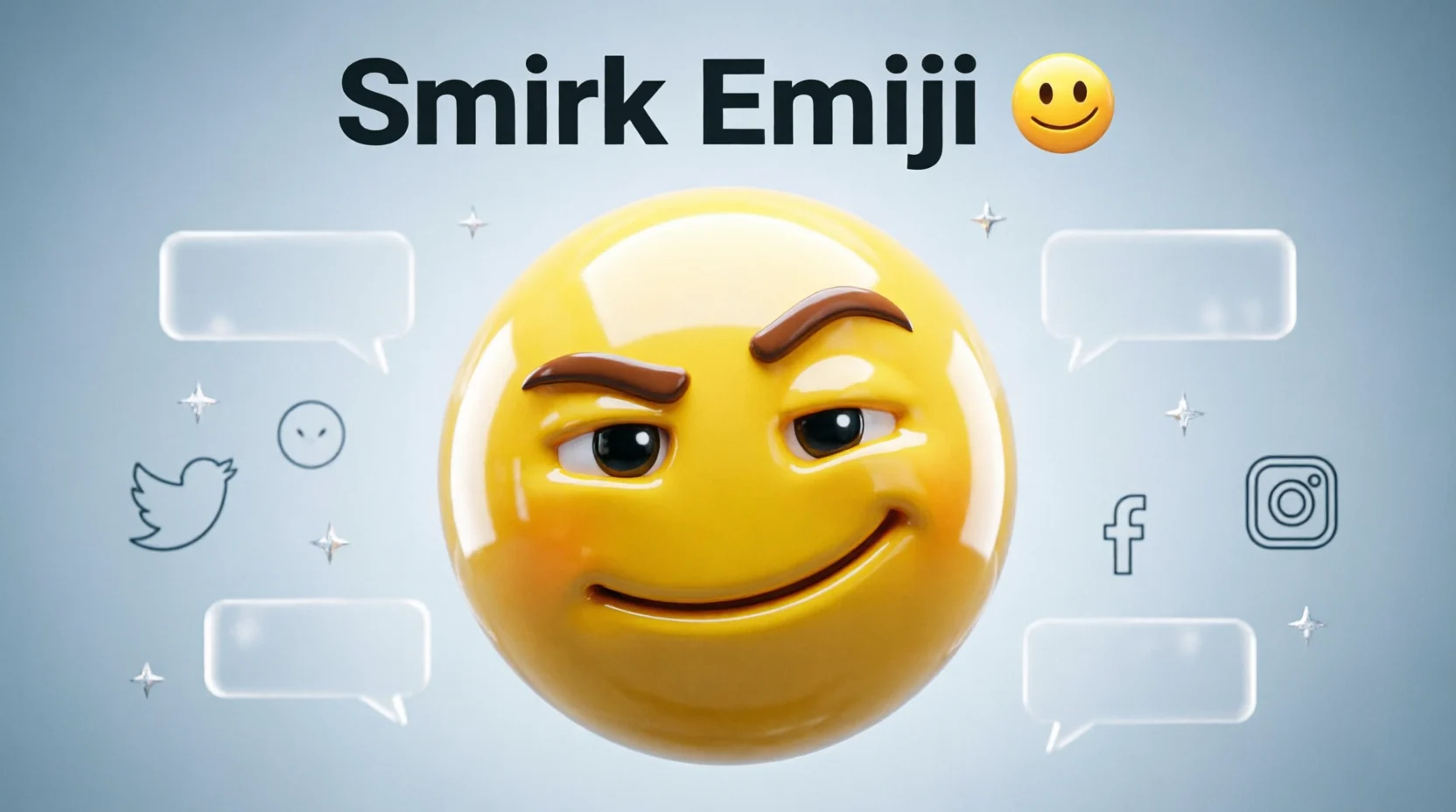
The smirk emoji 😏 usually expresses a confident, teasing, mischievous, smug, or slightly suggestive feeling. Its meaning depends heavily on the conversation and relationship between the people using it.
Someone might send 😏 to flirt, tease a friend, show confidence, or suggest that they know something others do not. Unlike a simple smile 😊, the smirk emoji often carries an extra attitude or hidden message. Understanding the context is important because the same emoji can sound playful in one conversation and arrogant or suggestive in another.
Quick Answer: What Does the Smirk Emoji 😏 Mean?
The 😏 smirk emoji commonly means confidence, teasing, flirtation, mischief, sarcasm, or smug satisfaction. It can suggest “I know something,” “I’m teasing you,” “You know what I mean,” or “I’m feeling confident.”
Its exact meaning depends on the words around it, the relationship between the people chatting, and the overall tone.
What Is the Smirk Emoji 😏?
The smirk emoji is officially associated with a smirking face. It shows a face with a small, knowing smile and a sideways-looking expression.
Unlike a broad happy smile, the 😏 expression feels more intentional and emotionally complicated. It can communicate an attitude rather than simple happiness.
For example:
- “I told you I was right 😏” can sound confident or smug.
- “Maybe we should hang out later 😏” can sound flirtatious.
- “You really thought you could beat me? 😏” can sound playful and competitive.
- “I know what you did 😏” can sound teasing or mysterious.
The emoji does not have one fixed meaning. Context determines the message.
What Does 😏 Mean in Texting?
In texting, 😏 is often used when someone wants to add attitude, teasing, confidence, or a hidden implication to their words.
Here are some common interpretations:
| Meaning | Example | Possible message |
| Teasing | “You really believed that? 😏” | I’m joking with you |
| Flirting | “You look good today 😏” | I may be flirting |
| Confidence | “I knew I could do it 😏” | I feel confident |
| Mischief | “I have an idea 😏” | I have something clever planned |
| Smugness | “Told you so 😏” | I was right |
| Suggestiveness | “Maybe we should talk privately 😏” | There may be a hidden meaning |
| Sarcasm | “Great job breaking it 😏” | I may not actually mean “great job” |
| Mystery | “You’ll find out later 😏” | I know something you don’t |
Because of these different meanings, reading only the emoji without considering the surrounding text can lead to misunderstandings.
Why Do People Use the Smirk Emoji?
People often use 😏 because it adds personality to an otherwise ordinary sentence.
Text messages can be difficult to interpret because they do not contain facial expressions, gestures, or voice tone. Adding an emoji can help communicate the attitude behind a sentence.
For example:
Without emoji:
“You were wrong.”
With 😏:
“You were wrong 😏”
The second version may feel more playful, teasing, or smug.
Similarly:
“See you tonight 😏”
can sound very different from:
“See you tonight 😊”
The first may suggest flirtation or a private joke, while the second generally feels warmer and more innocent.
Is the Smirk Emoji 😏 Flirty?
It can be flirty, but it is not automatically romantic or sexual.
This is one of the most common misunderstandings about 😏.
When someone uses it after a compliment, invitation, or suggestive comment, it may indicate flirting.
Examples include:
- “You look amazing tonight 😏”
- “Maybe I’ll save you a seat 😏”
- “I have something special planned 😏”
- “You’re trouble, aren’t you? 😏”
- “Come closer and I’ll tell you 😏”
However, friends can also use the same emoji while joking around.
For example:
“You ate the last slice, didn’t you? 😏”
Here, the emoji can simply make the accusation playful.
How to Tell If 😏 Is Flirty
Look at the whole conversation, not just the emoji.
Possible signs of a flirtatious use include:
- Compliments about appearance
- Romantic or playful messages
- Invitations to spend time together
- Private jokes between two people
- Teasing about attraction
- Suggestive wording
- A pattern of affectionate or flirtatious communication
One 😏 by itself does not prove romantic interest.
😏 vs. 😊: What’s the Difference?
The difference between 😏 and 😊 is mainly about attitude and emotional tone.
| Emoji | Common feeling | Typical tone |
| 😏 | Smirk | Teasing, confident, mischievous |
| 😊 | Smiling face | Warm, friendly, happy |
| 🙂 | Slight smile | Neutral, polite, calm |
| 😉 | Winking face | Playful, joking, flirty |
| 😎 | Cool face | Confident, relaxed, stylish |
| 😌 | Relieved face | Peaceful, satisfied, content |
| 😄 | Big smile | Cheerful, excited, friendly |
A message such as “Good job 😊” sounds encouraging.
“Good job 😏” can sound like the speaker knows something else or is teasing you.
That small difference can completely change the perceived tone.
😏 vs. 😉: Are They the Same?
No. The two emojis can overlap, especially in playful or flirtatious conversations, but they usually create different impressions.
😏 Smirk
The smirk often communicates:
- Confidence
- Hidden knowledge
- Mischief
- Self-satisfaction
- Teasing
- Suggestiveness
😉 Wink
The wink often communicates:
- A joke
- Playfulness
- Friendly teasing
- Flirting
- “I don’t mean this completely seriously”
Compare:
“I know what you did 😏”
This sounds knowing or slightly smug.
“I know what you did 😉”
This feels more openly playful and lighthearted.
😏 Smirk Emoji Meaning From a Girl
When a girl sends 😏, its meaning depends on the context just as it does when anyone else sends it.
It may mean:
- She is teasing you.
- She is joking.
- She feels confident.
- She is being playful.
- She is flirting.
- She is suggesting an inside joke.
- She is being slightly sarcastic.
For example:
“You finally replied 😏”
could be playful teasing.
“You looked good today 😏”
could potentially be flirtatious.
“I already knew that 😏”
could simply express confidence or smugness.
The safest approach is to consider the actual words and conversation history rather than assuming a romantic meaning.
😏 Smirk Emoji Meaning From a Guy
A guy may also use 😏 to communicate several different emotions.
He might be:
- Flirting
- Teasing
- Showing confidence
- Making a joke
- Acting mischievously
- Being sarcastic
- Hinting at something
For example:
“I knew you’d say yes 😏”
could be playful confidence.
“You should come with me 😏”
could have a flirtatious implication.
“Guess who finished first 😏”
could simply be competitive teasing.
Again, the emoji itself does not establish someone’s intentions.
Examples of the Smirk Emoji in Conversations
Seeing real examples makes the different meanings easier to understand.
Friendly Teasing
Friend: “I finished the assignment before you.”
You: “You finally did something early 😏”
Here, 😏 adds playful teasing.
Flirting
Person A: “Are you free tonight?”
Person B: “Maybe… why? 😏”
Here, the emoji can make the response sound flirtatious or suggestive.
Confidence
Person A: “Do you think you can win?”
Person B: “I already know I can 😏”
The emoji emphasizes confidence.
Mischief
Person A: “Why are you smiling?”
Person B: “You’ll find out soon 😏”
Here, it creates a mysterious, mischievous feeling.
Sarcasm
Person A: “I broke your favorite mug.”
Person B: “Fantastic work 😏”
The emoji can signal that “fantastic” is sarcastic.
Common Phrases Used With 😏
The smirk emoji often appears after short phrases that already carry attitude.
Some examples include:
- “I know 😏”
- “You wish 😏”
- “Told you so 😏”
- “Maybe 😏”
- “We’ll see 😏”
- “I have a plan 😏”
- “Just wait 😏”
- “You already know 😏”
- “Interesting… 😏”
- “Are you sure? 😏”
- “I knew it 😏”
- “Don’t worry 😏”
- “Trust me 😏”
- “Guess what 😏”
- “That’s what I thought 😏”
The same phrase can have a completely different tone depending on the relationship and situation.
When Should You Use the Smirk Emoji?
The 😏 emoji works best when the conversation is already casual or playful.
Use It for Friendly Teasing
If you’re joking with someone who understands your humor, 😏 can make the message feel more playful.
Example:
“You really thought you could beat me? 😏”
Use It for Light Flirting
If both people are comfortable with playful flirting, it can add a confident tone.
Example:
“Maybe I’ll see you later 😏”
Use It to Show Confidence
It can emphasize a confident statement.
Example:
“I told you I’d finish it first 😏”
Use It for a Mystery or Inside Joke
It can suggest that you know something interesting.
Example:
“I’ve got a little surprise for you 😏”
When Should You Avoid 😏?
Although 😏 can be fun, it can also create the wrong impression.
Avoid using it when the conversation requires a serious, respectful, or professional tone.
For example, this may sound inappropriate in a workplace message:
“I’ll send the report tomorrow 😏”
A simple 🙂 or no emoji would usually be clearer.
You should also be careful when talking to someone you do not know well. They might interpret 😏 as flirtation, arrogance, or inappropriate suggestiveness.
Common Mistakes People Make With 😏
Assuming It Always Means Flirting
This is probably the biggest mistake.
The emoji can be flirtatious, but it can also mean teasing, confidence, sarcasm, or mischief.
Using It in Serious Conversations
A serious message followed by 😏 can make the sender appear dismissive or unserious.
Ignoring the Context
The words around an emoji matter. Always interpret 😏 together with the complete message.
Sending It to Someone Who May Misunderstand
If you barely know someone, a smirk can be interpreted more strongly than intended.
Overusing It
Using 😏 after every sentence can make your messages seem repetitive or overly suggestive.
How to Respond to 😏
Your response should depend on what you think the sender means.
If They Are Teasing You
You can respond playfully:
- “Oh, really? 😏”
- “Keep dreaming 😂”
- “Nice try!”
- “You think you’re funny, huh?”
If They Are Flirting
If you’re comfortable with the tone:
- “Maybe I am 😏”
- “Is that your way of flirting?”
- “Careful, I might believe you 😉”
- “Interesting… tell me more.”
If You’re Unsure
You can keep your response neutral:
- “What do you mean?”
- “Haha, what’s that supposed to mean?”
- “I’m not sure how to read that 😄”
This can prevent unnecessary misunderstandings.
What Does 😏 Mean on Social Media?
On social media, 😏 can have many meanings because users communicate through short captions and comments.
You might see it under:
- A confident selfie
- A funny post
- A playful challenge
- A romantic message
- A surprising announcement
- A teasing comment
- A joke between friends
For example:
“New look. What do you think? 😏”
Here, the emoji may add confidence or playful self-assurance.
In a comment such as:
“We know what happened here 😏”
it may suggest an inside joke or hidden context.
Practical Tips for Using 😏 Correctly
Before sending the smirk emoji, ask yourself three simple questions:
1. What tone do I want?
If you want warmth, 😊 may work better. If you want playful confidence, 😏 may fit.
2. Could this sound flirtatious?
If the answer is yes and that is not your intention, choose another emoji.
3. Does the other person understand my humor?
With close friends, teasing emojis are easier to understand. With strangers or professional contacts, ambiguity can cause problems.
A useful rule is simple: if the words are already playful, 😏 can strengthen the tone; if the message is serious, it can make the meaning confusing.
FAQs:
1. What does the 😏 emoji mean from a girl?
It can mean teasing, confidence, mischief, sarcasm, or flirting. The exact meaning depends on the message and relationship rather than the sender’s gender.
2. What does 😏 mean from a guy?
A guy may use 😏 to show confidence, tease someone, joke around, flirt, or imply that he knows something. Context is important.
3. Is 😏 always a flirty emoji?
No. Although it is frequently used in flirtatious conversations, it can also express smugness, teasing, confidence, sarcasm, or mischief.
4. What is the difference between 😏 and 😉?
😏 usually feels more knowing, confident, mischievous, or suggestive. 😉 often feels lighter, more openly playful, joking, or flirtatious.
5. Does 😏 mean “I know something”?
It can. When used after a mysterious statement, 😏 may suggest that the sender knows something that the other person does not.
6. Can I use 😏 with friends?
Yes. Friends commonly use it for teasing, jokes, playful competition, and inside jokes. Make sure the person understands your intended humor.
7. Is 😏 appropriate for work messages?
Usually, it is safer to avoid it in professional communication because it can sound sarcastic, smug, or suggestive. A neutral emoji or no emoji is clearer.
8. How should I respond when someone sends 😏?
Look at the surrounding message first. If it is playful, you can respond playfully. If you are unsure, ask what they mean rather than assuming it is flirting.
Conclusion
The smirk emoji 😏 is a flexible expression that can communicate teasing, confidence, mischief, sarcasm, flirtation, or a knowing attitude. Its meaning is not fixed, so the words surrounding it and the relationship between the people involved are essential for understanding its tone.
Use 😏 when you want to add a playful or confident edge to a casual conversation, but be careful in professional or unfamiliar situations. If a message containing 😏 seems confusing, focus on the complete conversation rather than interpreting the emoji alone.

I create fun, creative pickup lines and flirty messages that help people feel confident, spark conversations, and make their chats more playful, memorable, and enjoyable.